
Four Scientific Principles That Make Any Food Tastier
Building cooking intuition through chemistry

Illustration by Siddhi Bhandari
The most trustworthy source of food and
fitness journalism in the country.
Editor’s note: I don't spend nearly enough time in the kitchen anymore—though I used to be a proper cooking enthusiast when I lived in Mussoorie and made every single meal myself. My cooking skills are decidedly average (think: pretty decent scrambled eggs with basil, and chole chawal that'll make you happy but won't blow your mind), but I've always been obsessed with that magical "touch" some people have.
You know what I mean? The way my mum can take the exact same ingredients I use and somehow make them sing. Sometimes it's just a squeeze more lemon, a different garlic-to-onion ratio, or swapping one spice for another—and suddenly the same old curry hits different.
These observations confirmed that making food tastier didn't always mean loading dishes with butter. Sure, that works (hello, Bombay pav bhaji!), but understanding what creates flavour gives you so many more options, so you can hold your macros AND make delish food.
After making a video on flavours in packaged foods (and this TBT piece), I discussed this idea with Anushka Mukherjee: what if we found scientific principles behind great flavour and applied them to everyday cooking? Over the last few weeks, she researched and ran delicious experiments to bring you this piece.
PS: Here is a short feedback form to help us understand how we're doing. Would you please share your thoughts? Link here. Thank you!
– Samarth Bansal (samarth@thewholetruthfoods.com)
To talk about scientific ways to make food tastier, I think we should begin with intuition.
Intuition feels mystical and vague, but it's actually biological. The brain constantly processes every detail of your environment, then pulls from your memories, experiences, and everything you've learned. This reasoning hums "below awareness" until you need to make a quick decision—then intuition surfaces it all at once.
Back when I only reached as high as a pot being stirred on our stove, I stood in the kitchen all the time, watching my parents cook. My father challenged me nearly every day: just after beginning his curries, he would dip a spoon into the steaming pot and hand it to me, asking me to tell him what the curry needs. Spice? Sugar? I wouldn't know. Salt? He would ask me. I found it very difficult to understand whether it needed salt, and how much. Sometimes, I could tell it needed salt, but I didn't know how I came to that conclusion.
My father gathered my vague instincts into one neat formula that I use to this day: run through the list of ingredients and spices you just added. Green chillies, ginger, garlic, coriander, cumin, red chillies, sugar, tamarind. Can you really taste these? Like, properly? If you can't taste the ingredients you named, you need salt.
I'm talking about intuition because using science to make food tastier can feel dry and tone-deaf. But we have to understand that most home cooking is already scientific, without ever referencing textbooks or principles. Our mothers and grandmothers have been doing this for years—making intuitive choices that turn out to be quite scientific. They're built on thousands of years of trial and error that our ancestors performed for us, creating the longest-running science project ever. We are just carrying it forward.
This intuition comes from every food experience we've had: cooking, watching, tasting, learning. Many experienced home cooks spent so much time in the kitchen that their "below awareness" processing became razor-sharp.
But perhaps we don't spend as much time in the kitchen: we don't have to, choose not to, or simply cannot—and that's fine. It just means we have less opportunity to build this cooking intuition naturally.
My father's salt formula was exactly this kind of intuition—scientific without being academic.
He had learned that salt does more than just season food; it amplifies every other flavour, making the food loud, zingy, cohesive, and round. But salt is also, after all, just a mineral that reacts as a chemical does. And when it reacts with food in certain ways, food becomes tastier.
So here's my point: understanding the science of flavours is one way to build intuition from first principles. Little scientific tips don't just improve one dish—they return every time you enter the kitchen.
I decided to focus on some basic scientific principles that come into play in simple dishes, with examples I tested in my own kitchen. The trials were humbling, but largely successful!
Before we start, acknowledgements: Most of my learnings come from researching the science of cooking, especially as contextualised by Samin Nosrat's Salt Fat Acid Heat, Krish Ashok's Masala Lab, Maxime Bilet and Nathan Myhrvold's Modernist Cooking series, Bernard Lahousse, Johan Langenbick, and Peter Coucquyt's The Art and Science of Foodpairing, and Barb Stuckey's Taste: Surprising Stories and Science about Why Food Tastes Good.
Tip #1: Brine, not marinate
Marination means soaking meat in a mixture of acids (like lemon juice, yogurt, or vinegar), oils, and spices. It's useful for several reasons: the acidic element helps tenderize the meat to a certain extent, if marinated for a while. The spices add flavour, and it's a great way to prepare meals ahead of time. It works wonderfully for grilled chickens or tandoori chicken.
But marination has limits. The spices only flavour the surface of the meat, and unlike what is commonly believed, marinating actually doesn't help get flavours deep inside the meat, or make it very soft.
Salt can do what marination can't. And it does that through brining, which means soaking meat in salt water (often with sugar and spices added).
Let me explain the salt-science behind this simple method (which might convince you to start brining your meats every single time).
When you place your meat in a salt solution for hours—a solution of salt, sugar and spices like whole pepper, bay leaves, cardamom—the process of osmosis begins.
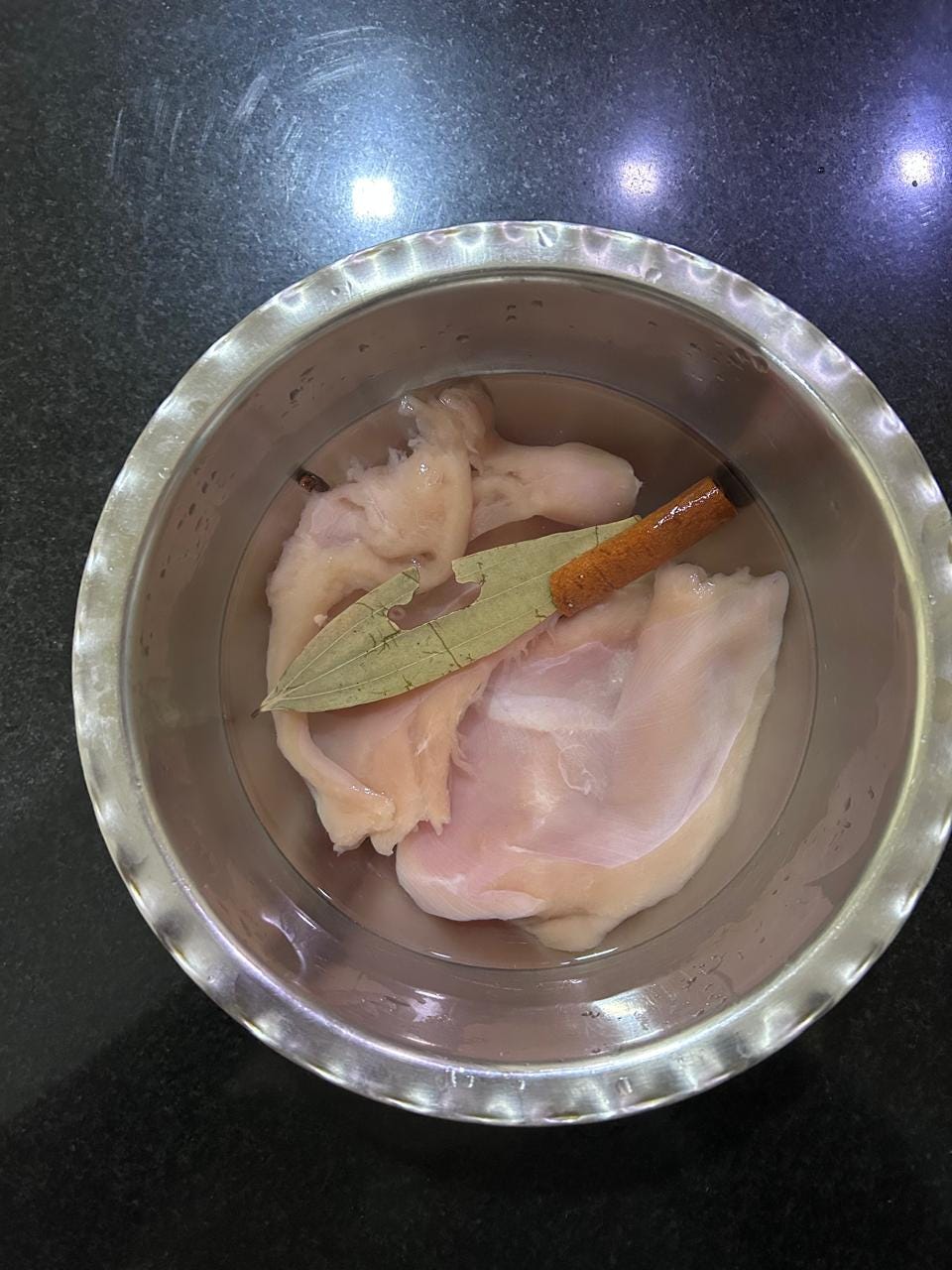
Osmosis is nature's way of balancing things out: water always moves through membranes to try and equalise concentrations on both sides. If the solution on one side is less salty (meaning there is more water than salt on this side), the water moves to the saltier side to try and dilute it.
Since your brine is much saltier than the inside of the meat, the meat first releases its own water into the saltier solution to try and dilute it. (This seems counterproductive, but stick with me.)
Then the magic begins. Diffusion kicks in—the reverse flow. Now salt (and those dissolved spices) start moving back into the meat because they want to spread out evenly too. And when salt enters the meat, it fundamentally changes the protein structure.
Imagine proteins as tightly coiled springs sitting compactly together. The salt gently uncoils these springs, stretching and relaxing them. This makes the meat softer, but more importantly, these relaxed proteins can now hold much more water than before.
Which means the meat gets back even more water than it lost, plus all the spices dissolved in that water. The salt has essentially rewired the meat to become a better sponge.
This is why brined meat stays incredibly juicy and tender, even after cooking. Osmosis and diffusion and the simple wonder of what salt does to protein.
I decided to try this with a simple recipe for fried chicken, but with a cut known for its ability to dry out quickly on cooking: the chicken breast. I brined, breaded and fried chicken schnitzels to make a sandwich with a garlic mint yogurt sauce, hot honey and creamy coleslaw.
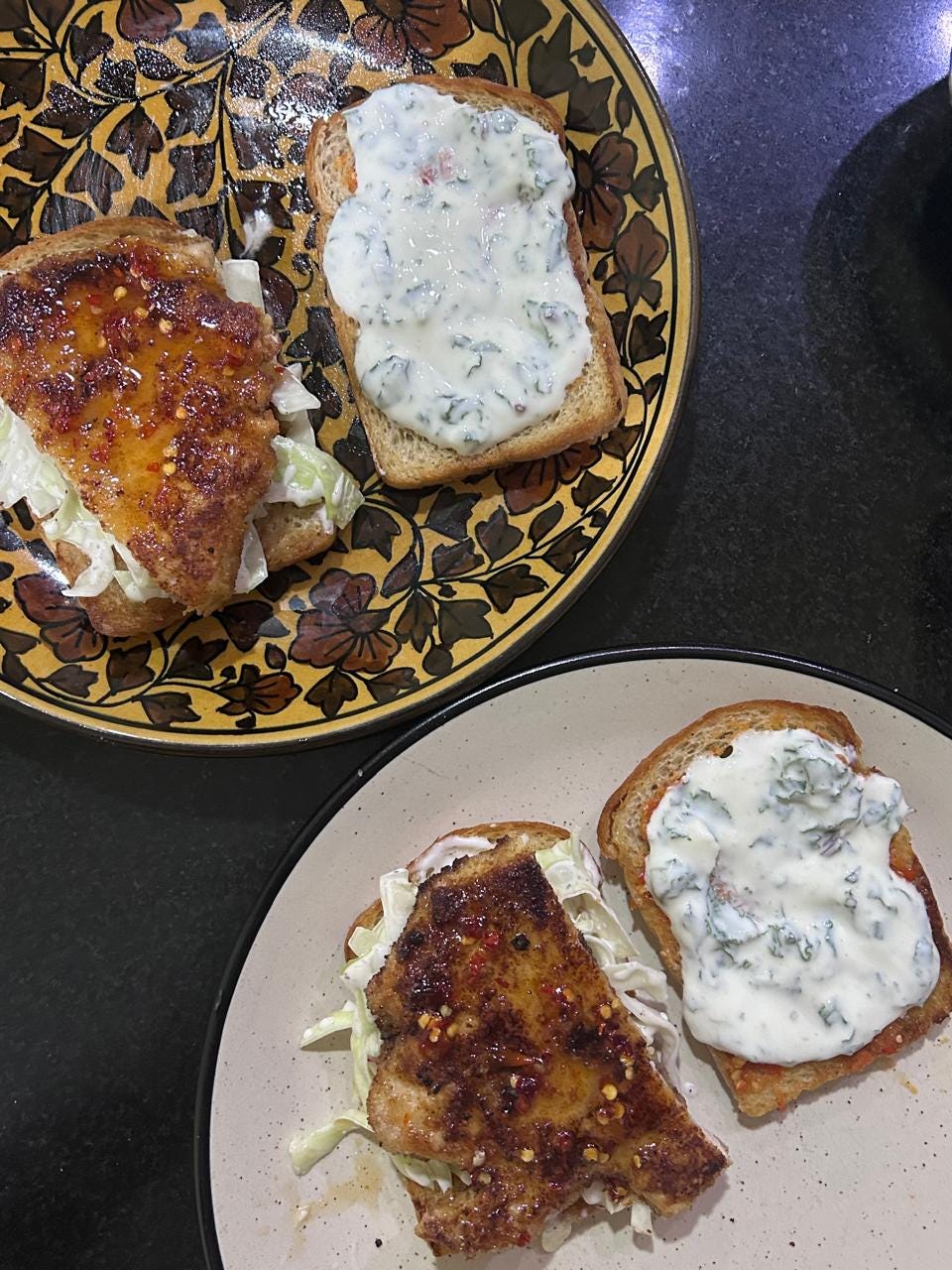
The chicken stayed very tender, very soft, even after cooling down. I’ve started brining meats all the time now, so I wasn’t surprised!
Tip #2: Maximise aromas
This is an easy one, and I've been experimenting with it constantly. It's built on one scientific principle: foods have aromas, but you can only smell them when the aroma compounds evaporate into the air.
Smell makes up 80-90% of what we think of as "taste". Anyone who lost their sense of smell during COVID will easily testify. But it's not just about inhaling food before you eat it. We actually smell food while chewing too, when we breathe out through our nose. This is called retronasal olfaction, and this is where most flavour really happens.
For both processes to work at their best, the smell molecules—called volatiles—need to vaporize into the air and reach your nose.
Volatile compounds stick easily to the olfactory receptors in your nose, and increase retronasal olfaction by leaps and bounds.
The more volatiles floating around, the more flavour you taste.
So this tip is simple: maximise your aromas. Chefs, tastemakers and food scientists use these techniques all the time:
A) Heat to release
Simple and obvious—a cold sandwich is far less appetizing than a steaming ramen bowl. But you can use this in tiny ways: heat bread for a few seconds before making a sandwich, or microwave tortilla chips or potato chips for a few seconds (before they go soggy) to wake up their aroma molecules.
B) Alcohol to extract
Alcohol has special abilities: it mixes with both water and oil, and has a low boiling point. This means it extracts aroma compounds and releases them as vapor. When you deglaze a pan with wine or add vodka to pasta, you're not tasting the alcohol—you're experiencing the supercharged aromas it releases as it evaporates.
C) Cut to break cells
You can manually release aroma, and this is one of those intuitive methods many of us already use. The principle: the finer you cut food, the more volatiles you release.
When you break down fresh foods like ginger, garlic and onions, you rupture their cell walls and free trapped aroma compounds: chop roughly for medium flavour, mince finely for strong flavour, make a paste for maximum impact.
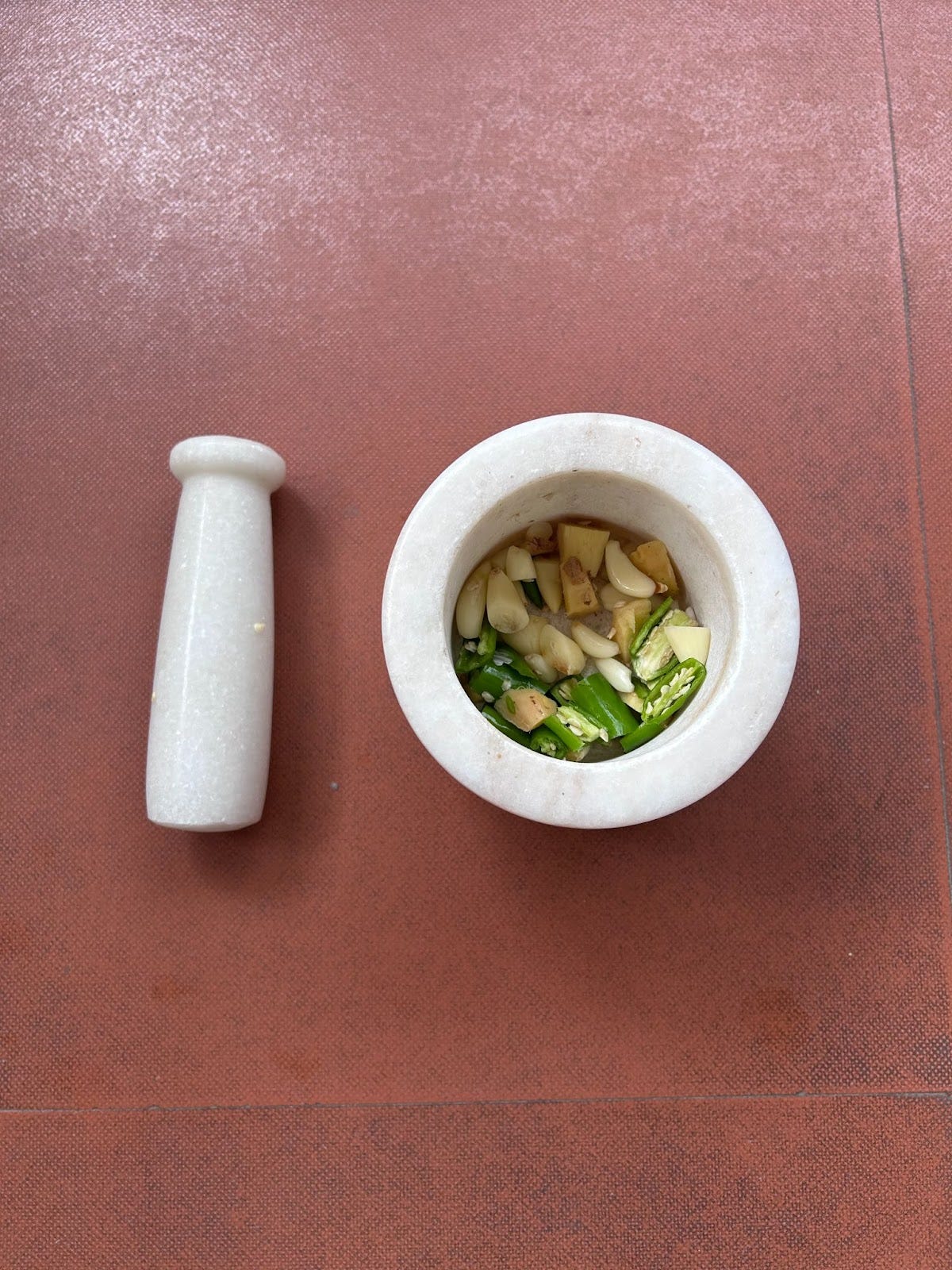
The same applies to fresh herbs: roughly chopped coriander is great as garnish, but it’s actually the finely minced or blitzed coriander that flavours the dish.
Pro tip: coriander stems contain concentrated flavour compounds. Wash off any dirt, chop finely, and add to curry pastes for a fresh but deeply flavoured kick!
Tip #3: Pair by molecules
This tip is more technical, but it's one of the most interesting ways to create flavour I've learned about, and it's helped me build cooking intuition in a strange, fun way.
In the late 2000s, a few chefs as well as scientists were exploring a concept in tandem: which foods pair well together, and why?
British chef Heston Blumenthal paired caviar with white chocolate and discovered how the chocolate became "smooth, buttery and briny." Around the same time, scientist Bernard Lahousse was exploring why certain flavour combinations work.
They discovered that each food contains multiple aroma molecules, some of which are volatile and vapourise in the air, creating a distinct smell.
And they found that foods that share similar aroma molecules often pair surprisingly well together—even foods you'd never expect.
Take kiwis—if you smell one deeply, you might detect subtle ocean-like notes. That's because kiwis contain the same grassy, fatty-scented aldehydes found in oysters and shellfish. Kiwis and oysters make a fantastic combination!
This opened up endless possibilities. The company Foodpairing has since analysed over 3000 ingredients, creating a database of which foods share molecular compounds. (I highly recommend their book Foodpairing for anyone willing to put in a little extra effort into creating new, surprising, delightful combinations.)
But I wanted to simplify this concept for myself, in a way that I could use in everyday cooking. So here goes.
In Indian households, spice combinations happen intuitively—sambhar masala uses coriander, peppercorns, cumin, and fenugreek; garam masala combines cardamom, cinnamon, cloves, cumin, and coriander.
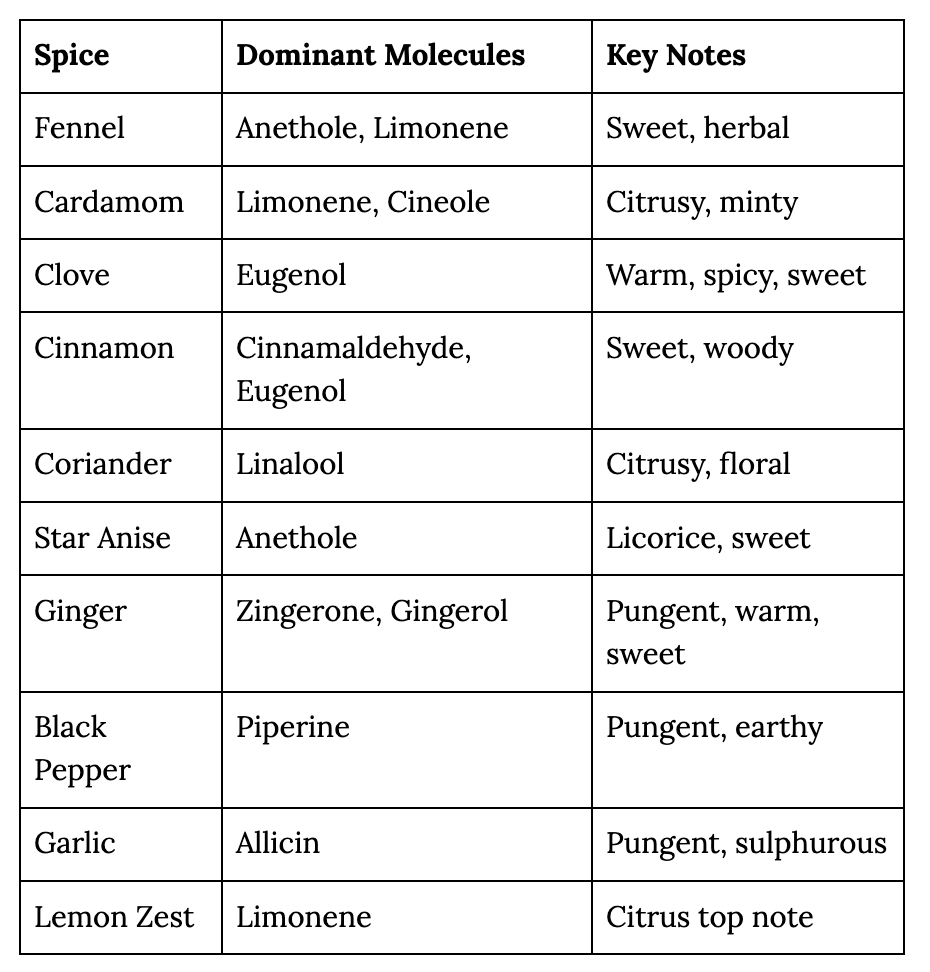
But for a quick sabzi or pulao, it's easy to fall back on the same 4-5 spices or use boxed powders that have lost their aromas. One scientific way to create new flavour combinations is to pair spices based on their dominant molecules.
I tested this with prawn pulao. Usually, I would put the usual whole spices in the oil first, and then add chilli, turmeric, cumin, and coriander powder, even some garam masala and aamchoor to the frying onions or curry paste. But I decided to be more intentional, using only a few spices—the right spices!
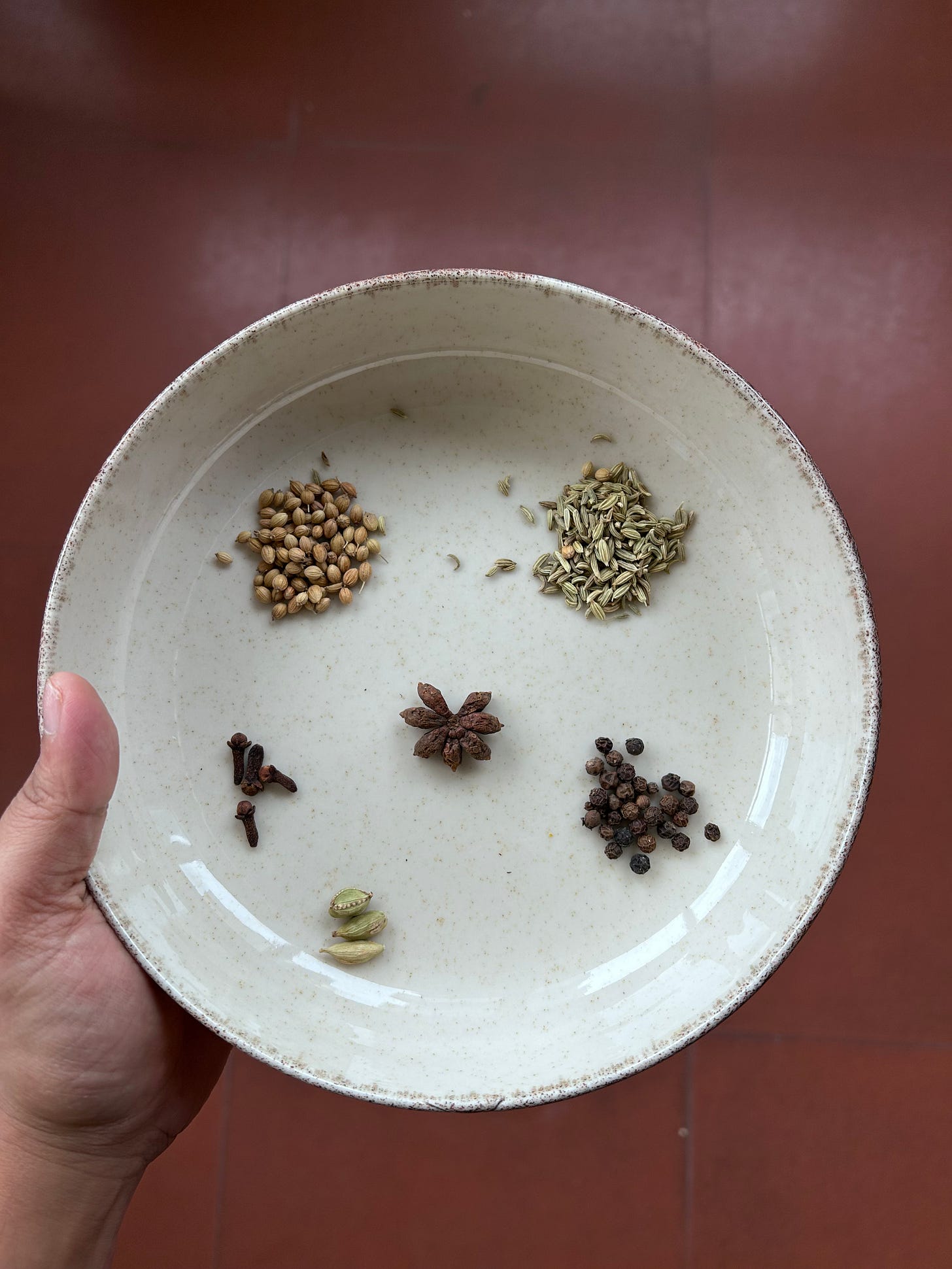
So I chose fennel, star anise, cardamom, and coriander seeds based on their shared compounds:
• Fennel + Star Anise (both contain anethole)
• Fennel + Cardamom (both contain limonene)
• Coriander + Cardamom (both have citrusy notes)
I ground these into a fine mix (the finer the grind, the more volatile compounds released!), and added it after frying off the onions and tomatoes. I only added a little bit of chilli powder and turmeric powder with the onions, but no other spices. The result was unique, subtle, and potent.
Pairings don’t have to be extensive, though. You can just find out the aroma molecules of a few ingredients and try pairing the most unusual two ingredients with similar molecules. Some delightful examples include:
- Strawberry and tomato
- Carrots and coriander seeds
- Peas and vanilla
- Beetroots and mushroom
This is the table I used to decide the spice mix.
Tip #4: Brown for flavour
Most people know that when meat or vegetables are seared in heat, they form a crispy brown crust—and this is called the Maillard reaction.
That's not wrong. But that's not all.
Actually, any browning you see in any food has undergone the Maillard reaction. It's all around us: in coffee and chocolate, in tandoori meats and baked breads.
Technically speaking, the Maillard reaction is a process that occurs when foods are heated to 110 degrees Celsius, in a completely dry process—so, without water or once all the water has evaporated. The sugars and amino acids in the foods react with each other and form the browning, releasing entirely new flavours and aromas. The reaction leads to the creation of hundreds of new molecules, and they give off aromas that can be nutty, caramelly, sweet, or savoury.
It's a process that extracts and creates maximum flavour from food. And it's the most intuitive step we use in cooking. This is why we brown aromatics like onion, ginger, and garlic first, or why we roast vegetables before blitzing them into soup.
Try incorporating the Maillard reaction more intentionally:
Deglaze your pans: When browning meats or vegetables, instead of adding water for a curry or sauce, add a splash of wine, stock, or balsamic vinegar to the hot pan first. This dissolves the delicious brown bits stuck to the bottom and captures those concentrated flavours before the next steps.
Don't stir too much: Constant stirring interrupts the browning process.
Brown proteins: The Maillard reaction needs amino acids, which are abundant in proteins. That's why meats and milk products like paneer brown so beautifully and develop such a delicious crust. Brown dal, fish, and tofu too!
Try baking soda: A tiny pinch (which is alkaline) can speed up the Maillard reaction.
I decided to test this with one of its most laborious illustrations—completely caramelised onions, which take 45-60 minutes but use the reaction to its fullest.
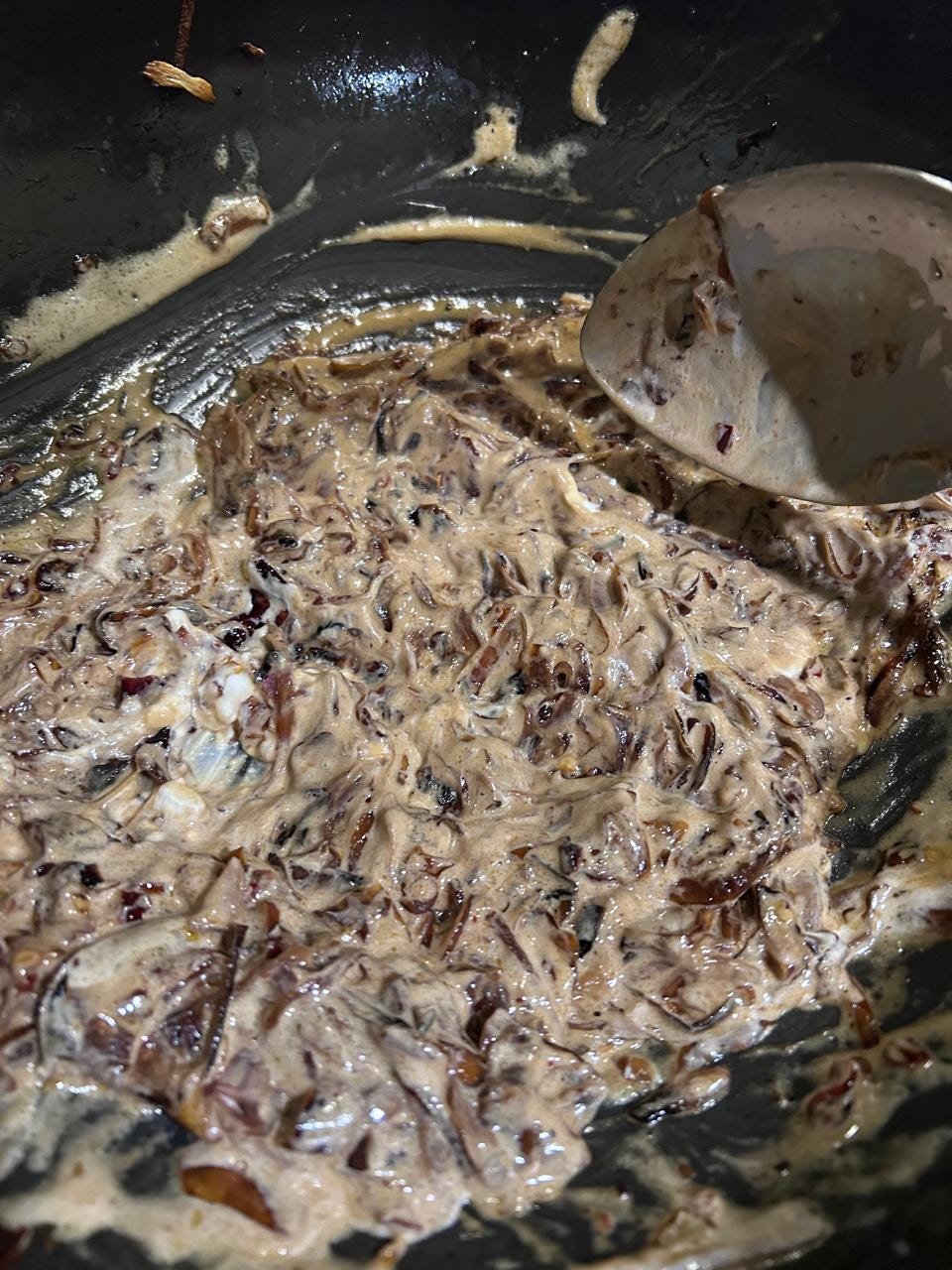
I made a creamy caramelised onion pasta with just onions, garlic, cream, red wine, salt, pepper, and sugar. It's important to slice the onions thinly—not just to release volatiles, but because the Maillard reaction happens at the surface of foods, where amino acids and sugars react in high heat. Thin slicing exposes more surface area to the pan and helps water evaporate quickly, which is essential for browning.
Onions contain a lot of water. So completely caramelised—or technically, Maillard-ed—onions take at least 40 minutes. They sweat out water, brown slowly, and become sweeter, jammier, while retaining umami. That's why this pasta needs so few other ingredients: onions, salt, sugar, red wine, cream and spaghetti.
The dishes in this piece were all tasted and approved by my closest friends and loved ones (happy volunteers who linger around my kitchen). For them, it's not the science that's exciting; it's knowing there are ways to make the same food we usually eat tastier.
By the end, when we all sat down to eat, I had forgotten about science anyway.
There are infinite ways to make food tastier. Understanding science and first principles is one way. Trial and error at home—arguably a very scientific method—is another. Asking your grandmother, another good one. Eating with good company, undeniably so.
All of it feeds your humming, hungry intuition. And that's what good cooking really is.
If you want to try out the recipes mentioned in the article, Anushka has created a document with all the information you need: Three recipes that use science to make food tastier. Happy cooking!