How did we get egg yolks so wrong? They are fine.
Half a century of demonising eggs was based on a misunderstanding of fats. Here’s what the science actually says.

The most trustworthy source of food and
fitness journalism in the country.
Welcome to Truth Be Told, the food and health journalism publication published by The Whole Truth Foods.
Editor’s note: Hi there, Samarth here. Today’s piece is the standalone explainer I promised after our two-part investigation on eggs (read part one and part two here). Is the yolk bad for you? Does it lead to heart disease?
Well, no. Really. My colleague Anushka Mukherjee did a deep-dive into the science and history of this cholesterol confusion, and the verdict is clear: egg yolk is not the problem. And yet, the confusion persists. Why? Read Anushka’s piece to find out. This piece genuinely clarified a confusion I’d been carrying myself.
As always, for thoughts and feedback, write to me at samarth@thewholetruthfoods.com. I’m sure some of you have opinions on this one, and I’m waiting to hear them.
— Samarth Bansal (samarth@thewholetruthfoods.com)
I.
The egg. Small, simple, ordinary. But demonised for the better part of half a century. From the 1960s, when the American Heart Association (AHA) firmly told the nation to cut back on eggs, all the way to the 2000s—and even now—when the fatty egg yolk retreated into the background as egg-white omelettes and egg-white-everything became the symbol of “healthy” eating.
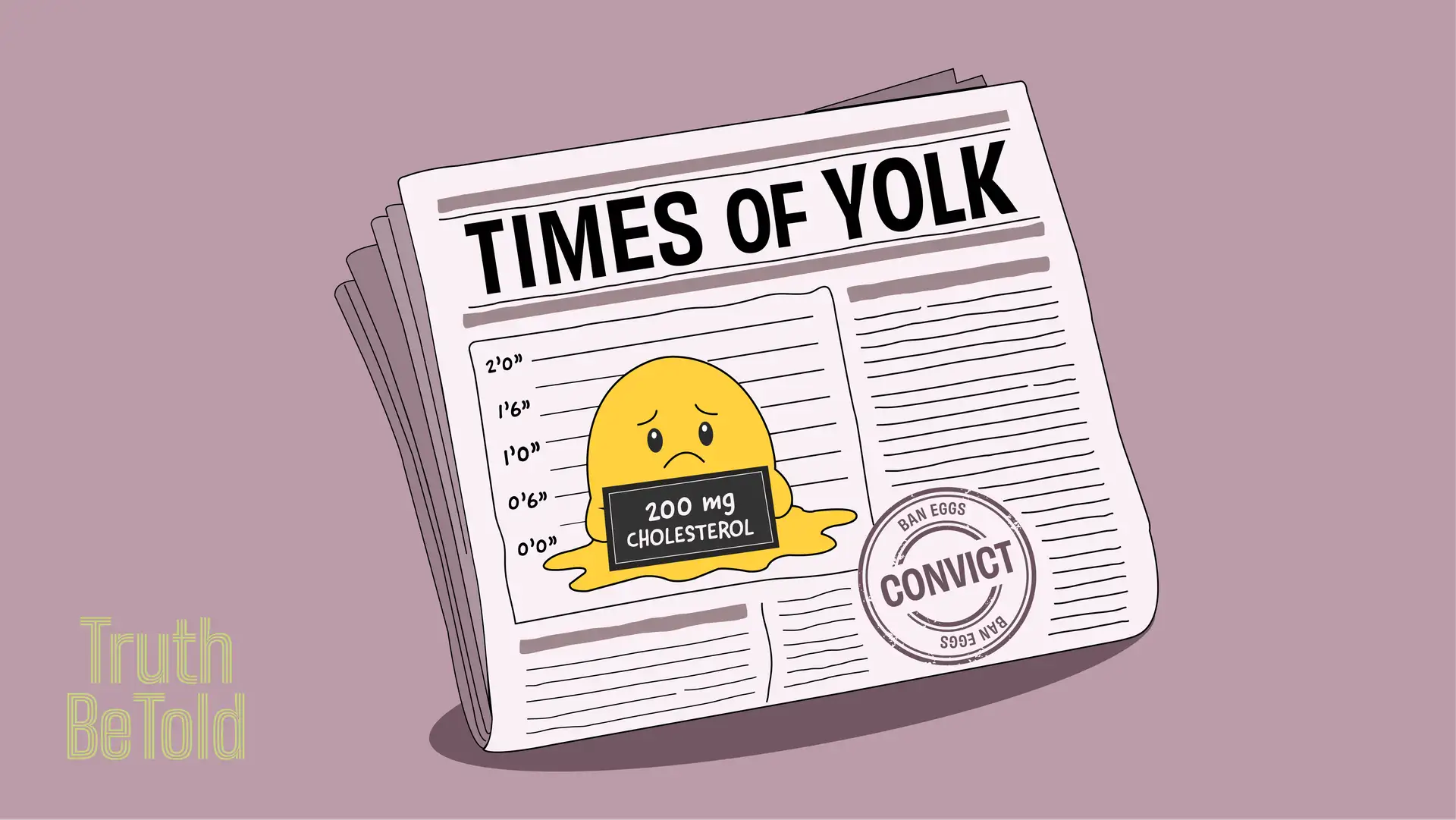
This is because while the milky egg white is mostly water and protein, the yolk is a dense little ball of micronutrients. But never mind that. The yolk is also almost 30% fat, and each one carries around 200 mg of cholesterol.
And a few decades ago, it was commonly understood that cholesterol in food increases the cholesterol in your blood. As soon as we proved that high blood cholesterol, in turn, causes heart disease, the verdict was simple: skip the yolk.
Put that into perspective for the egg: In 1977, the US Dietary Guidelines capped cholesterol intake at no more than 300 mg per day. For one egg at 200mg, over two-thirds of your daily allowance was gone. Two eggs? You’re over the limit.
And so, eggs—specifically, egg yolks—became the villain.
Except that this logic—that higher dietary cholesterol leads to higher blood cholesterol—is wrong. And we have known for a while now. What’s off here has a long, winding story rooted in a misunderstanding of fats and cholesterol.
So much confusion, over such a long time, that it still prevails today.
II.
At the core of this story are two different things: cholesterol and saturated fat.
1) Cholesterol is a waxy, fat-like substance (a lipid, specifically) that the body needs. It uses cholesterol to build cell membranes, produce hormones, make vitamin D.
But nowhere in the body is cholesterol more needed than in the liver: it synthesises 80% of all the cholesterol circulating in our blood, and needs it for multiple functions, including producing bile. The rest comes from food. Animals produce their own cholesterol, but plants don’t. So, you will only find cholesterol in animal products.
2) Saturated fat is a type of fat, made up of fatty acid chains. These chains are “saturated” with hydrogen—every available spot on the carbon backbone is taken—and that’s why these neatly packed molecules tend to solidify at room temperature. Think butter, ghee, or coconut oil in your cool, dark kitchen.
Saturated fats and cholesterol are completely different, with distinct chemical structures, and they have different roles to play in our body (barring some overlaps).
But they often get tangled because they appear together in the same foods. Saturated fats are more prominent in animal products (we produce it in our body) and cholesterol, as we know, is only found in animal products. So butter, ghee, cheese, red meats—are all high in both saturated fat and cholesterol.
The confusion was valid, even scientifically speaking. Early studies into the link between diet and cardiovascular disease found that people with an increased risk of heart disease ate a lot of foods high in saturated fats. And that the same people had elevated blood cholesterol. So the blame landed on both saturated fats and cholesterol.
The two stayed knotted together, appearing side by side not just in further studies, but also in the language we used around heart health. We still do this.
For example, plant-based cooking oils—like seed or rice bran oils—that claim to be “good for your heart” by being low in saturated fat also come with a promise, printed in big bold letters on the packet: “cholesterol-free.” What do the two even have to do with each other in these oils? No plant based oils contain cholesterol anyway.
At the time, a primary, looming fear unified all these concepts, blurring them together in the collective pursuit of defeating it: heart disease. We simply didn’t understand what was causing heart attacks—at least not enough to prevent them—or what increased the risk.
It took us a long time to figure it out.
III.
In the 20th century, a grim mystery confounded scientists studying hearts and metabolism: a lot of young people—younger than 30—were dying of heart attacks. After years of research, the cause emerged: abnormally high blood cholesterol.
But what caused this level of blood cholesterol in otherwise healthy, young patients? It wasn’t their diet, lifestyle or habits.
In 1938, Carl Müller, a Norwegian clinician, described it as an “inborn error of metabolism” that produces high blood cholesterol. It was genetic. You were born with it. It even had a name now: familial hypercholesterolemia.
But what was it? What did this particular gene do, to make the body vulnerable to nearly double the blood cholesterol—specifically, low-density lipoprotein or LDL cholesterol—than normal?
We wouldn’t find the answer for another 50 years.
In the meantime, researchers had started understanding cholesterol better. We knew that cholesterol was a lipid molecule essential to the body, produced by the liver.
We also learned that cholesterol is used by cells throughout the body, and so it has to be transported across our bloodstream by two vehicles: LDL (low-density lipoprotein) and HDL (high-density lipoprotein).
LDL carries cholesterol to different parts of our bodies, where it is used up by cells. But if there is excess LDL in the body, these free-flowing cholesterol molecules are picked up by HDL, which carries them away to the liver. The liver excretes them, and that’s that.
This is what we mean by “good” and “bad” cholesterol—though it’s a bit of a misnomer. There is only one cholesterol; just two transporters.
And it is these transporters that matter more than the cholesterol itself. If there happens to be more LDL in the bloodstream than HDL—that’s where the problem starts.
LDL particles get pushed into the walls of our arteries, where, with no HDL coming to pick them up, they stay. Once lodged there, they get oxidised (meaning, chemically damaged) and the immune system treats them as a threat. White blood cells rush in to clean up, get stuck themselves, and over time the whole mess hardens into plaque.
This condition is called atherosclerosis, narrowing the arteries and restricting the flow of oxygen to our heart. And, ultimately, increasing the risk of heart attacks and ischemic strokes.
So, when we say LDL is “bad,” all we mean is that more LDL can start this chain. It is a slow, silent process that only becomes visible when something goes terribly wrong.
But the question is: what causes excess LDL?
IV.
The first question is: does cholesterol from food—that is, dietary cholesterol—lead to an increase in the cholesterol levels in our blood?
Nope. Not for most people.
Dietary cholesterol has very little effect on your blood cholesterol.
This is because the body is adept at handling its cholesterol. Your liver has a homeostasis system that produces and regulates cholesterol in your body.
“If the dietary cholesterol coming from food is less, then the body compensates by synthesising more in the liver,” Sudha Vasudevan, Senior Scientist and Head at the Madras Diabetes Research Foundation, told me. Inversely, if you consume excess cholesterol, the homeostatic system dials its production down.
In fact, even if you’re not consuming any dietary cholesterol, your body will produce its own, to keep everything running. This is why even vegans can have high cholesterol even though they’re eating no animal products at all. Their liver is producing its own cholesterol.
It seems simple enough. In fact, many American scientists in this space already knew the weak link between dietary and blood cholesterol decades ago. Why have we believed this for years, then?
Over a hundred years ago, we just didn’t really know how cholesterol works in the body. But scientists and researchers had been suspecting that cholesterol in our food does have something to do with plaque buildup. So, in 1913, two Russian scientists, Nikolai Anichkov and Semen Chalatov, fed rabbits a diet of eggs, milk, and meat—all cholesterol-rich foods.
The result was striking: the rabbits developed lesions that closely resembled human atherosclerosis. Interest stirred. The evidence seemed undeniable, and the dietary-to-blood cholesterol hypothesis was born.
But there was one thing that the scientists—and their supporters—failed to take into account. Rabbits are herbivores. They never encounter cholesterol in their natural diet, and their bodies have no mechanism to absorb it or use it. Feeding cholesterol to a rabbit is like pouring petrol into a diesel engine. Of course something breaks.
When this experiment was repeated in rats and dogs, it did not yield anything close to the same result. The experiment was real. The extrapolation to humans was the flaw.
But, as Daniel Steinberg explains in his book, “The Cholesterol Wars,” this set off a decades-long confusion. In the US, at the turn of the century, it was no small thing to say that milk, eggs, and red meat cause heart disease. Deniers were as loud as supporters, and further flawed studies muddied our understanding. It is only towards the 2000s that a flurry of new research started to clear the fog. Even then, it would take a decade for policy to shift.
Finally, now, we are clear: the cholesterol in your food has very little meaningful effect on your LDL.
V.
The next question is: if not cholesterol, does the saturated fat in your diet raise blood cholesterol?
The short answer is yes.
Remember the genetic condition that dramatically raises LDL in the blood? In the 1970s and 80s, researchers Michael Brown and Joseph Goldstein studied particularly tragic cases of the condition, in children as young as 8. A pattern emerged: there was something on the surface of the body’s cells controlling the delivery of LDL to the cells.
In 1985, they won the Nobel Prize for discovering this path-breaking mechanism: LDL receptors.
Every cell in our body has these LDL receptors—and the liver, the body’s cholesterol capital, has 70% of all the receptors in our body. Whenever cells need cholesterol, these receptors grab the LDL travelling through the blood and unlock the cholesterol into the cell.
In effect, the receptors act like a vacuum cleaner pulling LDL out of circulation. When there are fewer receptors at work, more LDL stays in the bloodstream, and ends up in artery walls, where it begins the slow path to plaque.
Saturated fat is what disrupts this system. When excess saturated fat reaches the liver, it signals the liver to reduce receptor production. Fewer receptors means less LDL getting cleared, which means more LDL circulating, which means more LDL ending up in artery walls. This is now well established in the research.
So the picture comes into focus: high saturated fat raises LDL. Dietary cholesterol, for most people, doesn’t.
Two molecules that often appear together in the same foods, but only one of them is doing the damage.
VI.
And in the last decade or so, health organisations have caught up to this. The 2015-2020 Dietary Guidelines for Americans removed the longstanding recommendation to restrict dietary cholesterol to less than 300 mg/day. No upper limit is now specified.
But each major health organisation has a hard upper limit for saturated fat. WHO, the US Dietary Guidelines and the UK NHS all recommend that no more than 10% of your daily calories should come from saturated fats. The American Heart Association (AHA) is even more aggressive at 6%.
Indian clinicians, too, agree on this. Dr. V. Mohan, a leading Indian diabetologist and Chairman of the Madras Diabetes Research Foundation in Chennai, told me: “Diets which are high in saturated fat, e.g. ghee and coconut oil, can increase LDL cholesterol levels.”
> “When considering diet, it is important to remember that it’s not one single food item which is taken which matters, but the whole of the diet. For example, in Kerala where coconut oil is used, fish is also consumed, which is very good, and neutralises it to some extent.”
The clinical advice has only just caught up with science, but it’s pretty clear: for heart patients, the priority is moderating saturated fat, not avoiding nutrient-dense foods like eggs because of their cholesterol.
VII.
The chain is much clearer now:
high saturated-fat intake → high LDL cholesterol → plaque buildup → increased cardiovascular disease risk.
Dietary cholesterol does matter, but not as much as saturated fat.
And again, this is not to say stop eating saturated fat. It’s not that one should stop eating butter or ghee. The point is moderation. The ghee in your dal tadka or butter in a yum cookie is not a problem—the problem is when each of your daily meals has ingredients with high saturated fat, which can shoot past the 10% quota so easily.
Alas, the hard part of moderating saturated fat in the modern food environment is the food we eat that we can’t see into. And the two biggest culprits are restaurants (where we can’t know which oil is being used, or in what quantity) and packaged foods (which freely use ingredients high in saturated fats, like palm oil, and trans fats too—which are even worse for LDL).
So yes, how to moderate saturated fat is a problem statement.
But that has got nothing to do with… egg yolk! Which has just 1.5gm of saturated fat. (For comparison: a flaky butter croissant has 10gm saturated fat!)
Which is all to say: eat the damn yolk!