
Parenting Your Parents
On the work nobody told millennials we’d be doing. And no one taught us how.

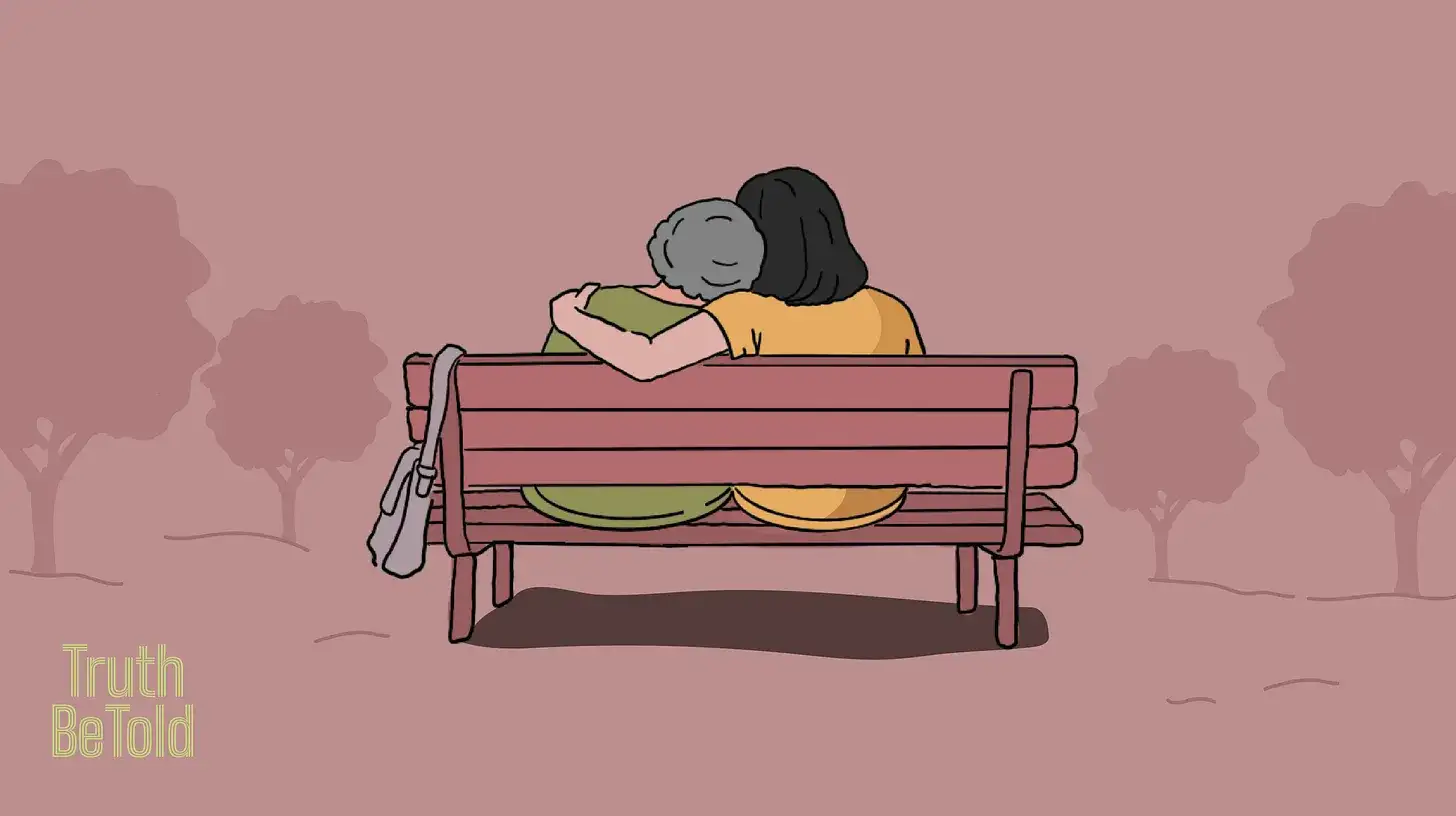
Illustration by Swaranjali Wadhawan
The most trustworthy source of food and
fitness journalism in the country.
Welcome to Truth Be Told, the food and health journalism publication published by The Whole Truth Foods.
Editor’s note: Hello, this is Samarth Bansal. Today’s essay by Ruchita Chandrashekar feels personal. It’s her story, and as a clinician her patients’ stories, but it is also my story. And the story of so many millennials who love their parents and want to give them care, but find that the world has changed around that desire—our aspirations, the early onset of disease, a healthcare system that asks too much of families. What remains, as she puts it, is a project management no one prepped us for, and emotional labour we simply weren’t prepared for.
I felt deeply seen reading this piece. I have not come across anything that captures a generation’s caregiving experience with this much care and empathy. How often we forget what a large part of our lives this is or becomes. If you’re a millennial with ageing parents, this piece will give you language for something you’ve been carrying without a name.
Ruchita is a behavioural health researcher and independent psychologist focusing on trauma and post-violence recovery. You can find her at https://x.com/roocheetah on X.
As always, write to me with thoughts and feedback and questions.
— Samarth Bansalsamarth@thewholetruthfoods.com
In early 2025, while having coffee with a friend, I asked her what changes she had made to her parents’ day-to-day lives to improve their quality of life.
‘Remember the painting and renovation from last year? I told them that we had to get the house painted or my fiancé’s family would judge us for having a badly maintained house. The leakage was unbearable and they refused to get any work done, because the building is supposed to go into redevelopment.’
‘No way, and they bought that?!’
‘I mean, I had to persist for a few weeks, about all the ways they would judge us. It’s far from the truth, but when has reasoning worked? I had to rely on some manipulation.’
‘The house looks great. You managed it well.’
‘I couldn’t bear the idea of them living in a home with seepage as their permanent roommate, after I’d moved out. I have tried to get this house repainted for years and they’ve pushed back with their redevelopment claims. If this building goes into redevelopment only by 2030, they’ll continue to manage, as they love to claim, like this?!’
Manage.
A word I had heard so often with every elder. Manage, adjust, compromise—elders throw around these words like medals of self-righteousness. I could hear the palpable anxiety in my friend’s voice—and the exhaustion. The mental labour of convincing ageing parents to collaborate on something that would improve their living conditions. Something they do not need to manage.
I know this exhaustion intimately. When COVID hit in 2020, I felt like the head of a household responsible for two senior lives that were willing to play chess with death. Their moves were ‘what can even happen?!’ and ‘we have already lived our lives!’. I moved back in with my parents for that year, and my hypervigilance had surpassed any ceiling I’d known.
Are they opening the door with a mask?
Did they sanitise that package?
Was that a sneeze? Is this from dust or is this the onset of the worst?
Now, my parents are guided by science. They believed that a deadly virus we knew nothing about had a very high potential to cause harm. But I continued to feel like I was at war with my arch nemesis: WhatsApp.
If you are a child of the baby boomer generation, you know that the biggest obstacle to rationality, reasoning, and coherent conversation with your parents is often WhatsApp. As a mental health clinician, it genuinely terrifies me to see how vulnerable this generation is to manipulation. Zoned out into their phones, swiping from one video to the next, it sometimes feels like watching a live simulation of dissociation.
The human brain is highly susceptible to conditioning through repetition. With repeated exposure to the same message, even firmly held beliefs can begin to wobble. You may know the sky is blue, but if someone tells you every day for a hundred days that it is pink, you are likely to doubt yourself at least once.
When I place this reality alongside the sheer volume of misinformation and harmful opinions older adults are exposed to daily, the implications are deeply unsettling. One forwarded message at a time, they are being quietly conditioned.
‘My father has been drinking a concoction of ginger, turmeric and amla every morning to cure his diabetes,’ said another friend. His father couldn’t let go of the 4pm chivda and the ‘sugar-free’ laddoo doused in ghee and jaggery, but he was fully convinced of the magical powers of ginger and amla. Because it is ‘natural’.
My parents are seduced by the word ‘natural’. Any attempt to educate them on the risks of such remedies is met with heavy dismissal.
Why? Because the power dynamic of most Indian families is rooted in authoritarianism. Age equals experience, experience equals wisdom, and the combination determines one thing with absolute certainty: an elder is always right.
I understand where this instinct comes from. Indian parenting evolved in conditions of scarcity, instability and limited social mobility. My parents are older children who grew up in the 1960s, often with one or both parents working all the time to make ends meet. My mother internalised obedience as support to her mother, raising 4 kids at home while her husband was in a different city. She saw how difficult but my grandmother’s circumstances were, and knew she couldn’t be an inconvenience. Challenging, as a behaviour, was never an option; so for the baby boomer generation, obedience was a survival tool.
When I ask my mother why she never challenged her parents, she says, ‘I didn’t know I could,’ in the most neutral, matter-of-fact way. Children of that generation became the primary vehicle for upward social mobility; success depended on discipline, conformity and performance.
But with millennials, something changed. I have an unconventional career in mental health, I studied abroad, I didn’t give into marriage when parents thought the ‘time is right’, I live alone. The exposure afforded to me was unimaginable for my parents. My confidence grew, my sense of self strengthened, I challenged their norms and ideas all the time.
My exposure to global ideas and the internet gave me alternative frameworks for identity, success and well-being. Yet my parents were raised without emotional validation or autonomy, making authority a substitute for emotional competence.
I see this mismatch in my clinical work constantly. It creates a deep generational barrier, and a very heavy emotional burden.
I’ve lived away from home for almost ten years. First, for higher education, then employment, and then because I wanted to. When access increased for millennials, so did distance. My biggest fear has always been a particular type of phone call. The one that tells you something has happened.
When I lived in Chicago, I became familiar with the anxiety of the middle-of-the-night call. It never came, but it could. I made sure I was always ready. The phone was on loud when I fell asleep. Even on DND, the settings ensured that my parents could always reach me.
There is something strange about a relationship with an imagined emergency—how we build multiple structures of access to feel a false sense of control, while internally scripting every worst-case scenario we must be ready to face. I still sleep with the phone on loud, only for two people.
I remember a conversation with another long-distance daughter who always had access to her mother’s location. ‘If I can see where she is, I am at peace. I don’t want to keep asking her where she is after 8pm, and then spiral as I wait for a response.’
We laughed at how bizarre that was, while also finding comfort in the shared absurdity of it. This is the reality of parenting your parents.
I was 29 when I first started tracking my parents’ yearly bloodwork, protein intake and routine of supplements. COVID was still thriving and I was determined to prepare my parents’ bodies to fight the virus with all their might. I felt promoted to a managerial role without any training or suggestion that I qualified for this so early. Tests were done more frequently, protein powders and Vitamin D supplements were part of every day diet, ‘sitting is the new smoking’ was frequented as a mantra in our living room.
What makes my generation’s experience distinct is not just the emotional weight, but the structural conditions it sits within. India’s life expectancy has more than doubled since Independence—from around 32 years to nearly 70—but this longevity has come with a [rising burden of chronic disease] (https://www.researchgate.net/publication/331558632LivingwithchronicdiseasesinIndia). Conditions like diabetes and hypertension tend to emerge a full decade earlier than in most Western countries, often becoming widespread by the 40s and 50s. This shifts the timeline of care: parents may begin needing support in their 50s and early 60s, precisely when their children are still stabilising careers, finances and relationships.
At the same time, family structures have changed. Since 1971, the average Indian household has gone from 5.3 people to 4.4—more than one person fewer per home. The households with six or more members— the ones large enough to absorb the work of caring for an elder—fell sharply between 2001 and 2011, while smaller nuclear households grew.
So the physical architecture of distributed care has changed. The aunt who managed the medications, the cousin who drove to appointments, the grandmother who noticed when something was off—all of that is largely gone. What remains is the emotional expectation that care will still happen, just without the infrastructure that once made it possible. With fewer siblings, that expectation lands on one or two people. In my family, it is concentrated in me.
As a clinician, I see this clearly: the Indian healthcare system is not structured around the patient alone. It is structured around the assumption that a family will manage everything else. It assumes someone will be present at every appointment, because the doctor will not call you back. It assumes someone will collect the reports, because no one will courier them or upload them to a shared system. It assumes someone has memorised the medication schedule, because the prescription is written in shorthand only the pharmacist half-understands. It assumes someone will notice the mood change, the weight loss, the new confusion, and know whether it is worth a visit or just age doing what age does.
That someone is usually us.
Take a 68 year old with a cardiologist at one hospital, a nephrologist at another, and a general physician somewhere in between. None of them speak to each other. His daughter, calling from Pune, is the only person who knows he is on three medications that interact badly. She found out by googling at midnight, then spent forty minutes on hold trying to reach the cardiologist’s clinic the next morning.
Or a 72 year old whose GP noted “mild forgetfulness” in her file two years ago and moved on. No one explained to her son what to watch for or when to worry. He assumed it was normal ageing. By the time he noticed the pattern—the same story told three times in an hour, the missed bill payment, the stove left on—she had been quietly declining in ways that had a name, and a trajectory, and an intervention that had a better chance two years earlier.
This is the project management no one signs up for. Maintaining a shared folder of reports across four hospitals. Reconciling conflicting advice from three specialists who have never been in the same room. Knowing which pharmacy stocks the obscure cardiac medication and calling ahead on Thursdays because Friday they run out. Coordinating leave from work for the appointment which the specialist only offers on
Tuesday mornings.
There is minimal geriatric and mental health integration in our healthcare system. No psychoeducation on age-related anxiety or cognitive decline, because clinics are overflowing and care is centred around symptoms that can be treated as physical illness. So no one tells you the things that would have helped.
Like irritability in an ageing parent is not always personality. It is often chronic pain they do not have language for, or the specific anxiety that comes from feeling the body become unreliable—and not wanting to say so. Or when an older adult becomes quieter, less interested, slower to laugh, that is not always just getting old. It is frequently undiagnosed depression, which can be both treatable and commonly missed.
Do you know which one is your parent? Most of us don’t. Not because we aren’t paying attention, but because nobody told us what to look for.
The logistics are only half of it.
There is another layer that sits underneath the spreadsheets and the pharmacy runs, one that is harder to name and easier to dismiss. It is the emotional labour of managing not just your parent’s health, but their fear. Their denial. Their bargaining.
The father who refuses to believe the diagnosis because accepting it would mean accepting that his body has changed and he is no longer the person who does not need help. The mother who cries at 10pm and does not know why, and neither do you, but you stay on the call anyway because hanging up feels like abandonment. The parent who snaps at you for the very care you are providing, and the particular exhaustion of absorbing that without flinching, because you understand, intellectually, that it is not really about you.
This is invisible work. It does not appear on any discharge summary. No specialist accounts for it in a fifteen minute consultation. And yet it is happening in living rooms and on phone calls and in the middle of the night, quietly, without a name.
I have sat across from exhausted adult children in my practice and watched them realise, sometimes for the first time, that what they are feeling has a name. Caregiver grief. Anticipatory loss. Chronic sorrow. The strange guilt of wishing, just briefly, that you did not have to carry this—and then hating yourself for the wish.
These are real, recognised experiences. They are not weaknesses. They are what happens when love is load-bearing and no one has offered to help hold it up.
Who carries this? We do. Without acknowledgement, without support, and often without even a language for what we are going through. The clinician in me can explain why. The daughter in me is still overwhelmed.
The way to break this isolation is to start talking to each other. The 11pm voice note to a friend who just gets it. The group chat that started as a joke about our parents’ WhatsApp forwards and became the place where someone finally admitted they cried in the car after dropping their mother at the hospital. The coffee where you say, out loud, that you are furious at your father for not taking his medication, and the person across from you does not flinch, because they said the same thing last week. Shame cannot thrive in company. Guilt needs companionship. Burnout worsens in silence.
Conversation disarms dismissal and creates language for an experience riddled with overwhelm. More importantly, talking to each other is how we learn—the strategies, the negotiations, the logistics, the small preventative measures that make a difference. We need a community to survive this new shift in the Indian family system.
And amid all the pressure, the stress and the spreadsheets of care, I hope we find ways to laugh at the chaos of it all.
My parents have a name for me. Warden. They have inside jokes about me, like giggling teenagers confronted with the same authority figure—except this one monitors their protein intake and step count and scolds them for watching too many reels.
I have seen fear in their eyes when I’ve caught them eating biscuits with their coffee at 7am. I have heard their negotiating pleas to count sambar as a protein source. Sometimes they send pictures of their sprout salad to get on my good side. Sometimes they claim protein powder causes kidney damage to get on my last nerve.
This, too, is managing. Not the resigned, medal-wearing kind my friend and I spoke about over coffee. The other kind—the kind that shows up, that negotiates, that manipulates where it must and loves through all of it.
For the rest of my years as the invisible head of this family, I shall wear the title of Warden with pride. Maybe get it printed on a T-shirt for the next family holiday, while running a quiet tally on their chips intake.
Here is a short feedback form to help us understand how we’re doing. Would you please share your thoughts? Link here. Thank you!