What Exactly Are We Paying Double For When We Buy "Organic"?
What two months of reporting taught me about what the organic certification promises, what it doesn’t, and what else to look for.

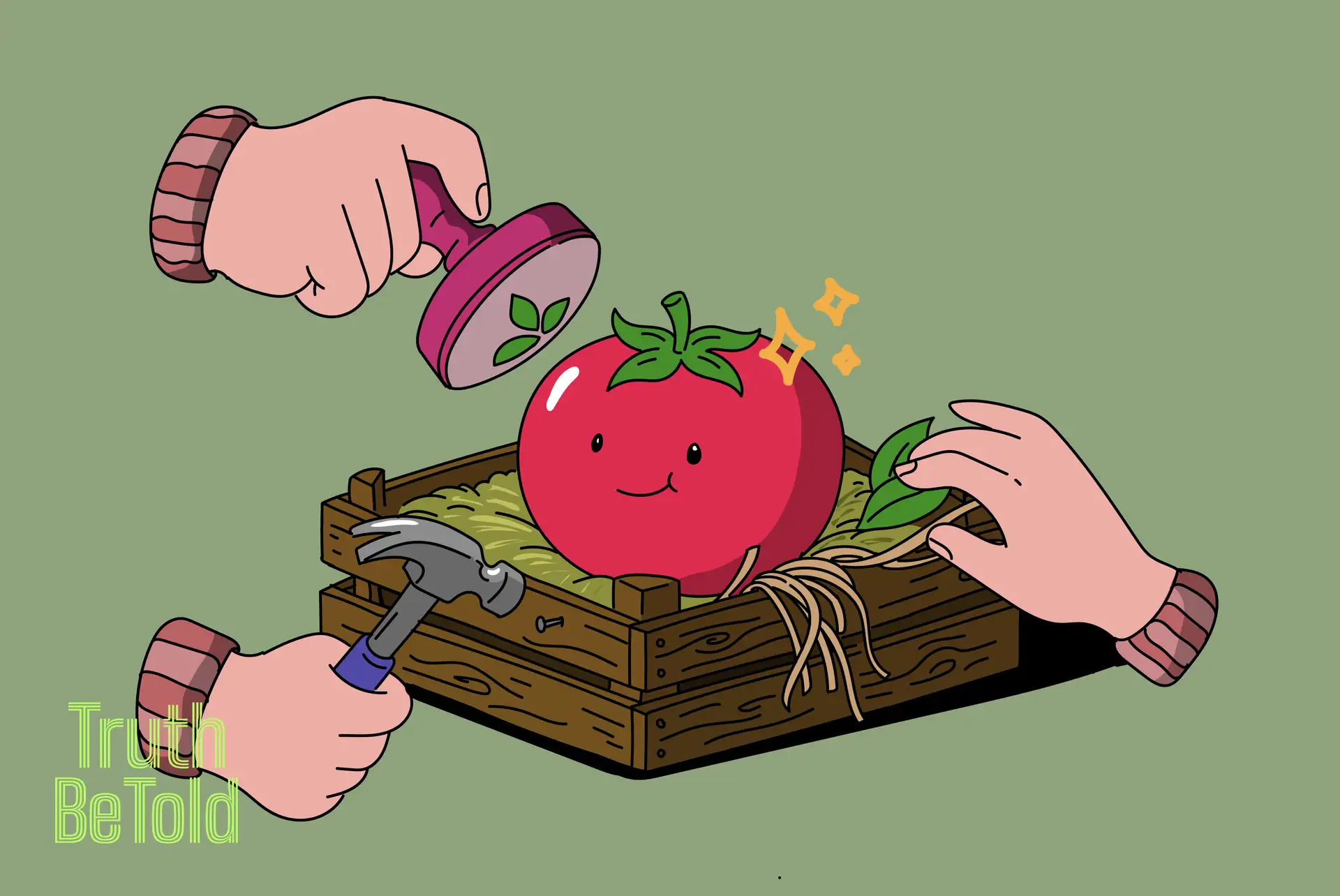
Illustration by Siddhi Bhandari
The most trustworthy source of food and
fitness journalism in the country.
Welcome to Truth Be Told, the food and health journalism publication published by The Whole Truth Foods.
Editor’s note: Hello, this is Samarth. Today’s piece is by my colleague Anushka Mukherjee, where she decodes one of the most confusing labels I find when shopping: organic.
To be honest, I am one of those people who didn’t mind paying extra for something a retailer had stamped as organic. It felt like I am doing myself a favour—but I never really understood why.
I do know that every label has a whole machinery behind it: a set of assumptions and ideas that some system has decided upon. The label itself is often only a proxy for something larger. Anushka’s piece reveals the system behind “organic” and leaves us with some helpful ideas for buying better.
I learnt so much from her reporting, and hope you do too. If you have thoughts or personal experiences of buying organic that you’d like to share, please do. There is so much more to learn here, and we’d love to hear from you.
My email is samarth@thewholetruthfoods.com
— Samarth Bansal
One of my favourite labels, when I shop for groceries, is “organic.” There is something about the word: it feels earthy, natural, right. It is at once exciting and vague. In fact, organic food might just be quite so exciting because it is vague. It allows me to project onto it what I believe to be better, healthier food.
And it is everywhere. Open Blinkit and you’ll find “Trusted Organic” vegetables, “Certified Organic” packaged goods, and products bearing the government-backed Jaivik Bharat logo—all sitting side by side, and all of them cost more.
Organic ghee is more than double the price of regular ghee. Organic Sona Masoori rice costs over twice as much per kilo. Organic carrots are nearly three times the price of regular ones.
We don’t generally begrudge these differences. The logic feels clean: organic should mean the food is free of chemicals, somebody should have tested and certified it, so we trust it. Of course it should cost more than bazaar ka aloo-pyaz.
Over the past two months, I spoke with half a dozen farmers across the country, independent certification agents and experts, trying to understand what organic actually means—as a label, as a practice and as a promise.
What I found is not that organic food is a scam. I’ve heard people around me say this, and my own parents are so sceptical of the label that they value their trust in local vendors above any certification.
What I found is something more specific and more useful: the organic label makes a much narrower promise than most of us think it does. And understanding that narrow promise clearly is the only way to actually use it well.
Here’s what I learnt.
I. What organic certification actually promises
When you pay double for organic ghee, the reasonable assumption is that somebody, somewhere, tested that ghee—checked it for chemicals, verified that it was clean—and gave it a stamp of approval. “Certified” makes it sound like somebody checked the product.
But that’s not what happens: certification does not test every product or batch. It primarily verifies a process.
The idea is: if the input process—how the food was grown, produced and handled—follows organic principles, the product should be organic.
For a farmer, following that process involves several things.
The first is paperwork. Farmers must submit a detailed Crop Production Plan: what they are growing, which inputs they use, how often they use them and what those inputs are made of. Each practice must be documented.
Rahul Mathur of OneCert explains that the documents are as important as the intention. “If somebody is doing it right, but it is not documented, then for us it is difficult to certify,” he says. “We know they may be genuine. But then, the requirement is not fulfilled.”
The second is a conversion period. A farm moving from conventional to organic agriculture must follow organic practices for a prescribed period—generally two to three years—before its produce can be sold as organic. To be sure, the waiting period does not in itself guarantee that every trace of previous contamination will go away. It simply establishes that the land has been managed according to organic standards for that period.
The third is a tightly controlled system of inputs. See, crops still need nutrients and protection. So it’s not that organic means farmers stop using fertilisers or methods of pest control. The restriction is on certain kinds of input, meaning farmers cannot use prohibited synthetic fertilisers, herbicides, fungicides, insecticides or growth regulators. They can still make natural inputs on the farm or buy commercial products from an approved list.
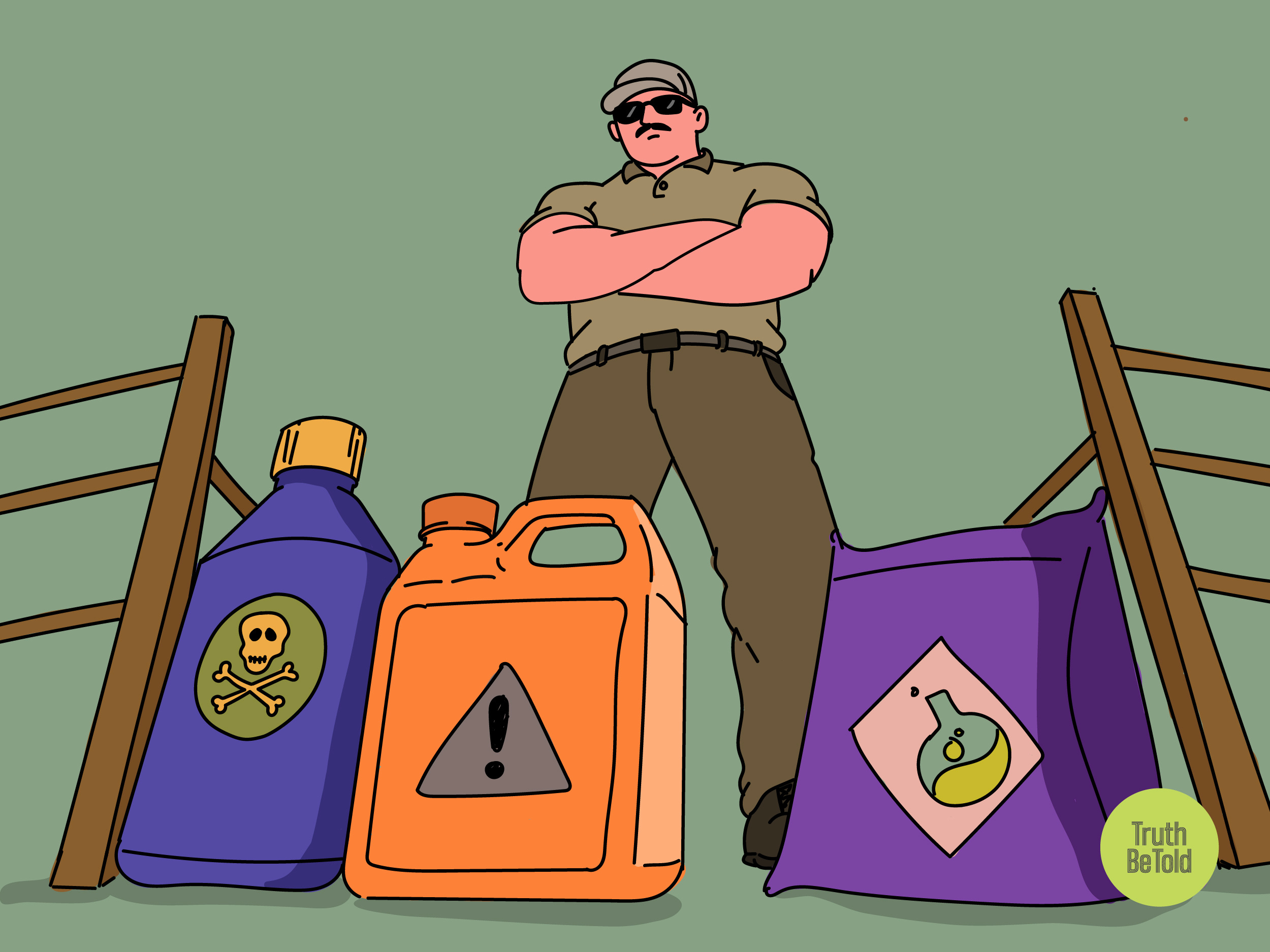
Illustration by Swaranjali Wadhawan
This is the fundamental premise behind organic certification: establish a production system in which prohibited inputs are not used, inspect and document that system, and therefore reduce the probability that the food emerging from it will contain those inputs.
This is the narrow promise organic certification makes: a commitment about the process, and not a batch-test of every product.
II. What the label cannot tell you
Once you understand the core promise, it’s easier to see what it doesn’t promise.
First, it doesn’t guarantee that organic food will be chemical-free. See, the food may well be free of residues because organic practices can reduce the risk of chemical exposure, but there are factors beyond the farmer’s control.
Think about it: crops can be exposed to contaminated water from shared water resources, wind drift from a neighbouring farm can introduce unwanted inputs, or contamination can happen during storage and transport.
Which is to say: “grown without prohibited synthetic inputs” and “tested and found to contain no chemical residues” are not the same thing. The latter would require lab testing of the final product. Certification may include selective sampling, but the logo does not mean that your particular product or batch was tested.
Second, it doesn’t guarantee that organic food will be more nutritious.
It is easy to assume that food grown using better practices will necessarily contain more vitamins, minerals and nutrients. But simply being produced without prohibited synthetic inputs does not automatically mean a crop’s nutritional composition has become better.
In 2012, Stanford researchers examined more than 200 studies comparing conventionally and organically grown food. They found little evidence that organic food was consistently more nutritious: vitamin content did not differ significantly, and phosphorus was the only nutrient found at significantly higher levels in organic produce.
To be sure, this is not a failure of organic certification. Because the certification never promised superior nutrition. But it is worth stating because many consumers interpret “organic” as a shorthand for food that is cleaner and healthier. Organic food may reduce exposure to pesticide residues, but the certification does not promise that it will be more nutritious.
So to sum up: the organic logo can’t tell you whether the carrots will be fresh, whether the rice will taste good, whether a product travelled 20 kilometres or 2,000, or what exactly the farmer is doing with the soil. Good things to know, but not answered through the certification.
III. How India checks the promise
In India, two government systems lay down the principal routes for organic certification. The National Programme for Organic Production, or NPOP, operates under the Ministry of Commerce through APEDA. The Participatory Guarantee System, or PGS-India, operates under the Ministry of Agriculture.
Both broadly define the agricultural practices required for food to qualify as organic. But they differ in who performs the verification.
NPOP works through third-party certification. An accredited certification body, independent of the farmer or food business, reviews the records, inspects the operation and decides whether certification should be granted or renewed. This requires money and relentless paperwork.
Fiona Arkal, who has been running Ishka Farms for over a decade, stressed how taxing it can be—financially and physically—to repeat the process year after year.
Aggregators and established farm brands can resource both the fee and the paperwork. But for a small or marginal farmer, it can become a real barrier.
So PGS exists as a more accessible alternative. Instead of relying primarily on an external certification company, local groups of farmers collectively commit to organic standards, educate one another and inspect each other’s farms.
This makes certification cheaper and accessible, but it does introduce a potential conflict of interest: the people carrying out the primary verification are also participants in the same farming community, not an independent third party.
Anil Jadhav of EcoCert described PGS to me as a “kindergarten” system: useful for helping farmers enter organic agriculture, he argued, but unsuitable for larger businesses or exports.
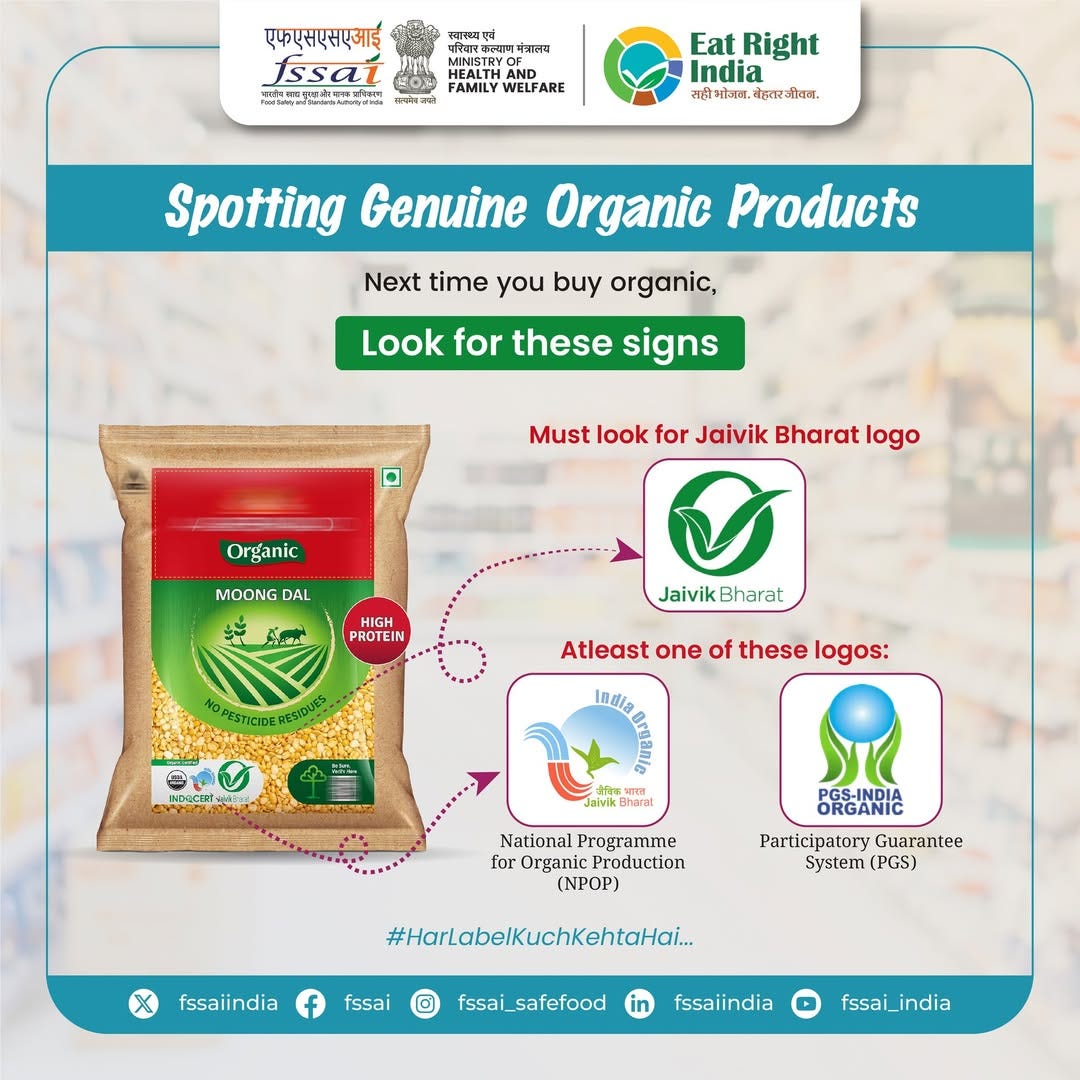
You can identify the route through the accompanying mark: India Organic for NPOP, or PGS-India Organic for PGS.
IV. Where the system becomes difficult to trust
A narrow promise can still be useful if the system reliably delivers it. But this is where the experiences of farmers and certifiers revealed gaps between the rules on paper and the quality of verification in practice.
Start with how inspections and sampling can feel on the ground.
Anjali Rudraraju, who co-owns Karnataka-based Yarroway Farms, says the certification agencies they have worked with take samples, but cannot test everything. “Each test costs them about 20,000 rupees, so they have to do random samples and work it out,” she explains.
Fiona of Ishka Farms found herself surprised by the absence of rigour when she first got certified. Certification actually relied less on physical checks and more on self-attested submissions from farmers, she discovered. In some cases, the paperwork is the verification.
Then there is the question of what happens when certificates lapse or when businesses use certification more expansively than they are entitled to.
Anjali pointed to a practical enforcement problem: once certification lapses, old packaging with the old certification claims may remain in circulation, and ordinary consumers are unlikely to check the current status of every product on an online portal.
Anil agreed that expecting consumers to verify certificate dates for each brand is unrealistic. The burden is more often taken up by business buyers, who ask suppliers for current certificates before making a purchase.
I can’t tell from these accounts how frequently such misuse happens. And this doesn’t mean the entire system is corrupt. But it does reveal clear vulnerabilities.
V. What you can actually do
Here’s what I am taking away from this reporting:
- I am going to stop treating “organic” as a category that is automatically better. Instead, I will ask what specific problem I am trying to solve, learn about it, and assess whether the claim I am paying for actually solves it. And if it can’t—and if the problem really matters to me—I will look for another way to solve it.
- If you want assurance about the production process, look for a recognised and current organic certification. Look beyond the common Jaivik Bharat logo for the India Organic or PGS-India Organic mark to know which route of verification was used.
- If your concern is what is present in the final food, look for actual test reports. For instance, if you are concerned about arsenic in rice, you need a test report that specifically measures arsenic. Even then, check which batch or sample was tested and what level was found.
- If you care about freshness and traceability, look at the length and transparency of the supply chain: where the food was grown, how long it travelled and how directly it reached you. A shorter supply chain is generally better. For me, the best option may eventually be to buy regularly from a farm I have taken the time to understand, perhaps through a subscription (though I haven’t done that yet).
- I don’t see myself giving up the neighbourhood sabzi market entirely. There, one anchor for eating better is to buy what is in season and add more variety to what I eat. Recently, that has meant eating—and loving—red amaranth, zucchini, Malabar spinach, jackfruit, litchi, corn on the cob and sweet potato.
None of these choices makes the food “organic.” And that’s my point: organic is only one way of asking whether food is better. There are many others, and we should know what we are paying for.