
5 Soy Myths That Won't Die (And Why They're All Wrong)
Thirteen years of eating soy taught me one thing: the fears don’t hold up.


Illustration by Sayali Kulkarni
The most trustworthy source of food and
fitness journalism in the country.
Welcome to Truth Be Told, a food and fitness newsletter published by The Whole Truth Foods.
Editor’s note: Today's piece is written by Shrey Khanna, my colleague at The Whole Truth, and not-so-secretly a soy fan. At the lunch table, he carries this extra box of roasted masala soy chunks that many of us want to munch on as a really good protein snack, wondering "ooooh you can make even soy chunks tasty!" which is when you know he's really into it.
But soy… oh, so many myths around it. From 'man boobs' to thyroid scares, soy has been blamed for it all. Shrey has eaten it for more than a decade, as have his clients. He previously founded The Fit Chase, an online fitness coaching platform, where he helped thousands with their fitness journeys.
So I asked Shrey to review the evidence on soy and explain what's behind those myths.
As always, write to me with thoughts and feedback and questions.
— Samarth Bansal (samarth@thewholetruthfoods.com)
If I had to name the single most consistent food in my 13-year fitness journey, it would be soy.
Not whey—that came later. Not paneer—that's been on-and-off thanks to its high calories. Not meat—I only added that after transforming my physique in recent years.
Soy, though? That's been there from the start.
When I began my fitness transformation, I had one mission: lose fat, build muscle, and make my diet efficient. Having been overweight and carrying a lot of chest fat, the internet whispers about soy causing "man boobs". That worried me. If I was going to make soy a daily staple, I needed to know it wouldn't make things worse.
So I dug in. Research papers, evidence-based creators, case studies. What I found was the exact opposite of all the fearmongering. Soy was a calorie-efficient, high-quality protein that ticked every box: a complete amino acid profile, easy to cook, affordable, versatile.
Over the years, it became a daily habit: around 50g of soya chunks most days, sometimes tofu or soy milk. It worked during cutting phases and maintenance phases, never causing the "side effects" people warned about. Same for the clients I've coached for years.
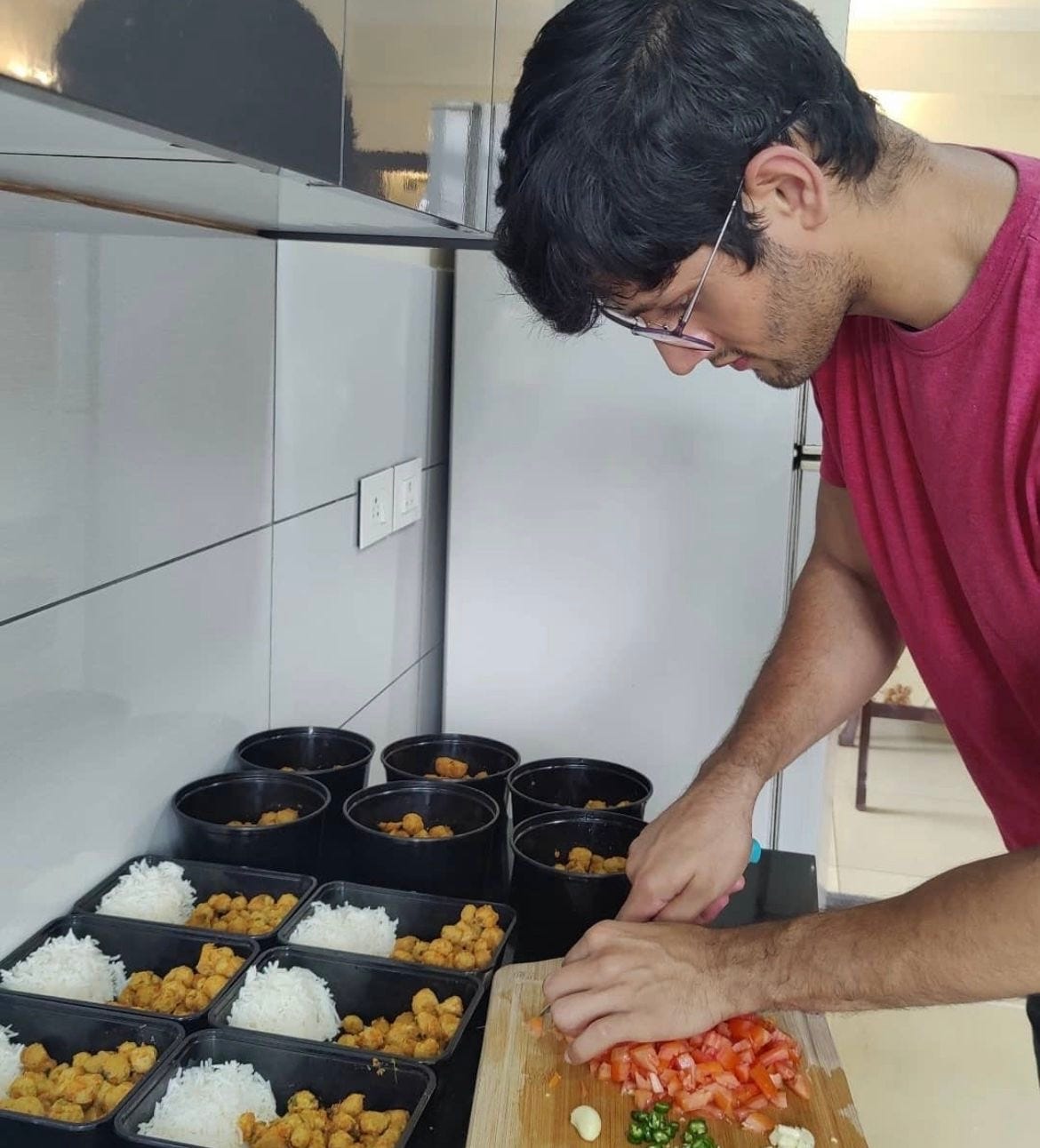 Shrey and soy
What is soy, anyway?
Soy comes from soybeans: small, beige legumes from the pea family that humans have eaten for thousands of years, starting in ancient China. From there, it spread across Korea and Japan, becoming a cornerstone of East Asian diets such as tofu, miso, soy sauce, and tempeh. The soy foods we buy today—tofu, soy milk, soya chunks—are just processed forms of this natural bean, like how milk becomes paneer or wheat becomes bread.
Yet despite being one of the most heavily researched foods with overwhelmingly positive evidence, soy's reputation never recovered from a handful of myths.
In today’s piece, I'm taking these myths head-on with research-backed evidence so you can see where the truth actually lies.
Let's get into it.
Myth #1: Soy is not a complete protein
First, let's understand proteins. Your body needs 20 different amino acids to build and repair muscle, make enzymes, and keep you healthy. Of these 20, your body can make 11 on its own. But the other 9—called essential amino acids—must come from food.
A "complete protein" is simply a food that contains all 9 essential amino acids in amounts your body can actually use.
The myth: Soy is an incomplete protein because it's low in methionine (one of those 9 essential amino acids) compared to animal proteins like eggs and milk.
Where this comes from: Soy does contain less methionine than dairy and meat. This bit is correct. But that doesn’t make it inferior. Why?
The reality check: That’s because "less than milk" doesn't mean "not enough." The World Health Organisation sets minimum requirements for each amino acid, and soy comfortably meets the methionine threshold to qualify as a complete protein.
Think about it this way: imagine you need Rs 50 to buy something. Soy gives you Rs 55, whilst milk gives you Rs 60. Both get the job done. Milk just gives you extra.
And eating soy with other foods throughout the day—like rice, nuts, or dal—would easily fill any methionine gaps. This is called protein complementation, and it happens naturally when you eat varied meals.
But how well does your body actually use soy protein? This is measured by something called PDCAAS. Which measures how much of the protein you eat actually gets absorbed and used. On a scale of 0 to 1, soy scores 0.91. That's almost as high as chicken (0.95) and beef (0.92), where 1.0 is perfect.
What about that study showing milk beats soy? There's a 2007 study where milk outperformed soy for muscle building in weightlifters. But the reason wasn't that soy is incomplete: it's because milk contained more leucine, a specific amino acid that acts like a trigger for muscle growth (about 2.8g vs soy's 2.2g). When later studies matched the leucine content, soy performed just as well.
What this means for you: Soy is absolutely a complete protein. If you eat it as part of normal meals—soya chunks with rice, or tofu with vegetables—you're getting everything your body needs. You might need a slightly larger portion than you would with milk to get the same leucine hit, but that's easily done.
If you’re a vegetarian trying to hit your protein goals, read more about this in our previous article.
Myth #2: Soy reduces testosterone and causes "moobs"
The myth: Eating soy lowers testosterone in men and leads to feminising effects like gynaecomastia (male breast tissue development, or "moobs").
Where this comes from: Soy contains phytoestrogens, which are plant compounds that can bind to estrogen receptors in your body. The main ones in soy are called isoflavones. Because these molecules look similar to human estrogen in structure, people assume they act the same way. And flooding your system with "female hormones" could lower testosterone and trigger breast tissue growth.
The fear seems logical, but here's the problem: Phytoestrogens aren't human estrogen. They're thousands of times weaker in potency. (Think of it like having a key that looks similar to your house key but barely fits the lock. And when it does, it hardly turns.)
These compounds actually work as Selective Estrogen Receptor Modulators (SERMs). That's a fancy way of saying they can have weak estrogen-like effects in some tissues, or even anti-estrogenic effects in others, depending on context. It's far more nuanced than "plant estrogen = feminisation."
What does the research actually show? Multiple high-quality studies—including systematic reviews combining dozens of trials—have found that soy intake doesn't affect testosterone levels in men. A 2021 meta-analysis looked at 41 clinical studies and concluded that neither soy foods nor isoflavone supplements reduce any reproductive hormones in men.
The reality check: I mentioned earlier that I was worried about this exact thing when I started eating soy daily over a decade ago. Thirteen years later, with 50g of soya chunks most days, I've experienced none of the feared effects. Neither have the hundreds of male clients I've coached who include soy in their diets.
What this means for you: The amounts of soy you'd eat in normal meals—tofu in a stir-fry, soya chunks in curry, a glass of soy milk—contain phytoestrogens so weak they have no meaningful impact on your hormones. This is a classic case of a scientific-sounding myth that crumbles when you examine the actual evidence.
Myth #3: Soy causes thyroid problems
The myth: Soy disrupts thyroid hormone production and can cause hypothyroidism.
Where this comes from: Soy contains goitrogens—compounds that can interfere with thyroid function in specific circumstances. Plus, a few studies from the 90s raised concerns that still circulate today.
The reality check: Here's what those scary studies actually found.
- A commonly cited study gave 60 people with already compromised thyroids concentrated soy supplements—not normal food. Even then, only some showed changes. When researchers repeated this with higher doses, they couldn't replicate the results.
- Another infamous 1991 Japanese study had just 37 people eating whole roasted soybeans. A few developed mild, temporary thyroid swelling that reversed once they stopped.
But there are many issues here. For one, 37 people is too small to draw meaningful conclusions. And then there was no control group, so you can't tell if soy caused any changes or if other life factors were involved. And crucially, they claimed problems from just 8-10g of soy protein daily. If that were true, Japan—where people eat 3-6 times more—would have a thyroid crisis. They don't.
What large-scale research shows: A 2019 meta-analysis of 18 controlled trials found no significant changes in thyroid hormones (T3 and T4) from normal soy consumption. There was a tiny rise in TSH (the hormone that tells your thyroid to work), but nothing clinically meaningful for healthy people.
The one legitimate concern: Soy can interfere with thyroid medication absorption. If you take thyroid meds, space them out from soy meals by a few hours. This is standard advice from endocrinologists.
What this means for you: If you're healthy with normal thyroid function, there's no evidence soy will harm your thyroid. If you have hypothyroidism, soy can still be part of your diet—just be mindful of timing with medication and consult your doctor about quantities and sources.
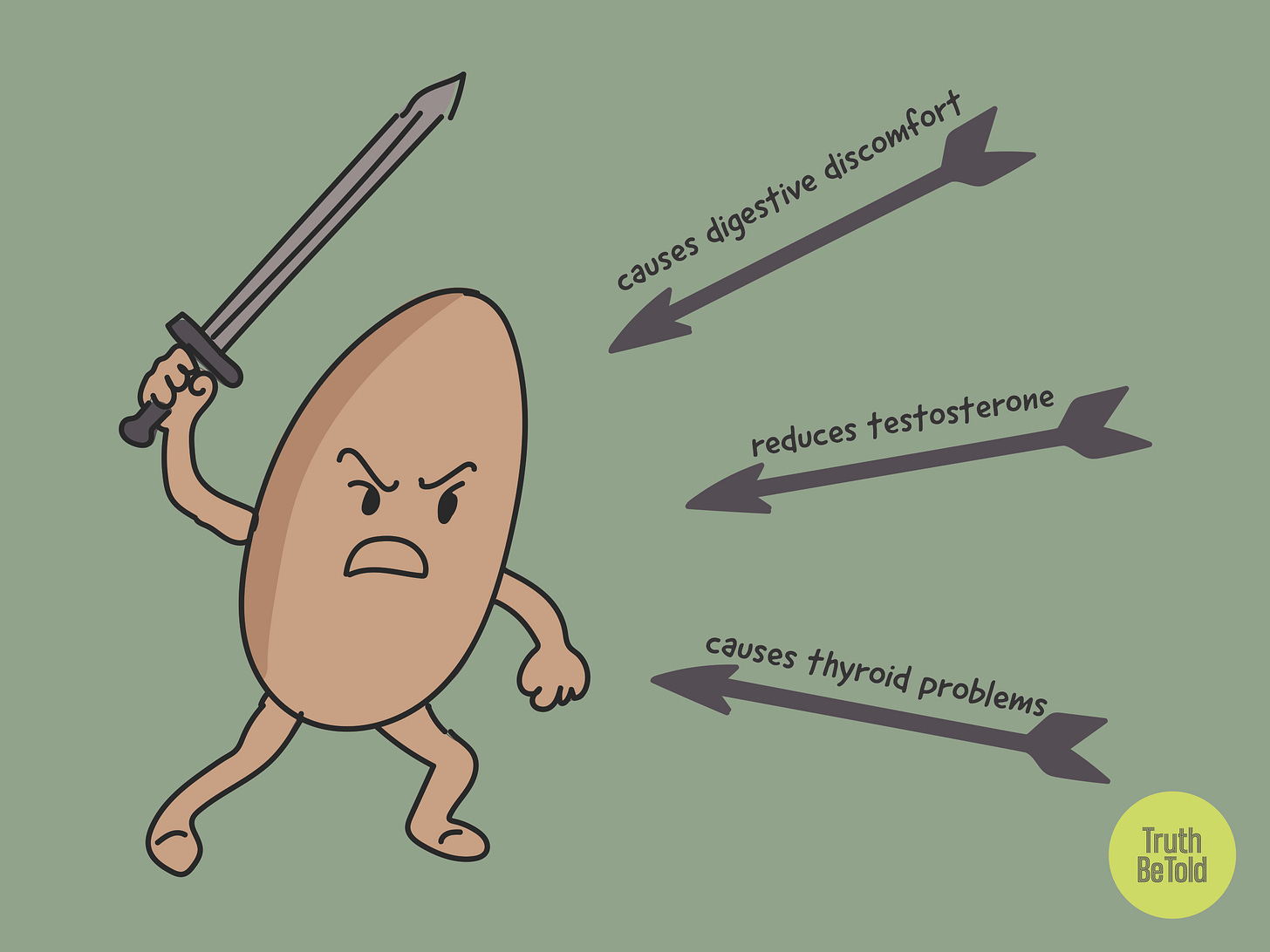 Soy fighting its bad reputation. Illustration by Sayali Kulkarni
 Myth #4: Soy causes digestive discomfort and gut issues
The myth: Soy is hard to digest and causes bloating, gas, and stomach problems.
Where this comes from: Some people do experience digestive issues with certain soy products. This is real, but it's not the whole story.
The reality: Some forms of soy contain compounds that can cause digestive discomfort in sensitive people—similar to how beans, wheat, or dairy affect some individuals. It's about personal tolerance, not soy being inherently "bad."
Here's what matters: Not all soy products are created equal when it comes to digestion:
- Tofu is usually well tolerated.
- Tempeh is usually easier to digest thanks to fermentation.
- Soy milk, soy flour, and soya chunks can be harder on sensitive stomachs
- Processing and preparation methods make a big difference
The lectin concern: You might also hear about lectins in soy causing "leaky gut." But lectins are destroyed by heat, and since we don't eat raw soy, this isn't a real concern.
What this means for you: If soy upsets your stomach, it's about finding what works for your individual tolerance—just like with any food. Some people can't handle dairy, others struggle with beans. Start with smaller amounts of easier-to-digest forms like tofu, and see how your body responds. It doesn't mean soy is unhealthy; it just might not be right for your particular gut.
Myth #5: Soy has antinutrients that block protein absorption, so it's not a good protein source
The myth: Soy contains antinutrients like trypsin inhibitors that interfere with protein digestion, making it a poor protein source.
Where this comes from: It's true that raw soy contains compounds called antinutrients—specifically protease inhibitors that can block protein-digesting enzymes. On paper, that sounds worrying.
The reality: First, antinutrients aren't unique to soy. Beans have lectins, spinach has oxalates, grains have phytates. These compounds are simply part of a plant's natural defence system, designed to protect its seeds from being eaten by pests and animals.
But here's the key point: we don't eat soy raw. We process and cook it first.
How processing fixes the problem: Cooking and processing denature trypsin inhibitors and unlock soy’s protein quality.
- Boiling or steaming destroys most protease inhibitors and raises digestibility.
- Fermentation (tempeh) significantly reduces antinutrients.
- Extrusion (used for soya chunks) denatures both protease inhibitors and lectins, unlocking protein availability.
What this means for you: When you eat soy in its common forms—tofu, soy milk, tempeh, soya chunks—you're getting high-quality, complete, and highly digestible protein that's just as effective as animal proteins for building and maintaining muscle. The antinutrient concern only applies to raw soy, which nobody actually eats.
Wrapping up
So there you have it: five persistent myths about soy, all put to rest.
- Soy is absolutely a complete protein.
- It won't give you "man boobs" or mess with your hormones.
- It's not going to wreck your thyroid (unless you have specific medical conditions)
- Digestive issues are about personal tolerance, not inherent problems with soy
- Processing eliminates the antinutrient concerns
As Harvard T.H. Chan School of Public Health notes:
> "Soy is a unique food that is widely studied for its estrogenic and anti-estrogenic effects on the body. Studies may seem to present conflicting conclusions about soy, but this is largely due to the wide variation in how soy is studied. Results of recent population studies suggest that soy has either a beneficial or neutral effect on various health conditions."
But I know what you're thinking: “Okay fine, but soy still tastes like cardboard.”
Look, I used to think the same thing. Until I realised it wasn't a soy problem, it was a skill problem. Soy needed better PR, and I needed to be a better cook!
Soya chunks are basically a neutral canvas. They absorb whatever flavours you throw at them. Spicy curry, biryani, stir-fry, soy kheema—the end result is all in your hands (and your masalas).
After 13 years of making soy work in my diet and helping hundreds of clients do the same, I can tell you: the taste "issue" is totally solvable. [[Link to recipes]](https://thefitchase.notion.site/69bc5f4b0d0b477a8b6ec051b57bdf6d?v=a60d90d46bf34179818c3728673a455d)
 The variety of soy recipes you can experiment with
The real question isn't whether soy is healthy. Because the science is clear on that. It's whether you're willing to give it a proper chance in your kitchen. I’d say… go for it!
For a comprehensive scientific review of soy and health, you can refer to this review.
Here is a short feedback form to help us understand how we're doing. Would you please share your thoughts? Link here. Thank you!