
A Letter to Anyone Walking Through Grief
Notes on grief’s shape, the rage no one warns you about, and how friends can truly help.


Illustration by Saumya Bansal
The most trustworthy source of food and
fitness journalism in the country.
Welcome to Truth Be Told, the weekly food and fitness newsletter published by The Whole Truth Foods.
Editor’s note: ‘Why would anyone want to read about grief when they are not grieving?’ was my editorial dilemma when commissioning the piece you will read today. But the answer became clear as I thought about the fundamentals: if this publication is anchored toward living a healthier and better life, it must include what happens when the inescapable truths of life’s counterpart—death—storm into our lives. We’re confronted with a feeling everyday life doesn’t prepare us for. When grief envelops your way of being. And then, no playbook works. But a letter from someone who has been there… might just help.
Amrita Tripathi’s warm, clear-eyed piece today does just that. She’s a writer and founder of The Health Collective. Her latest book is ‘The Other Sister’. Find her on X at @amritat.
— Samarth Bansal (samarth@thewholetruthfoods.com)
It’s accepted wisdom that Grief doesn’t go away on its own.
That it’s a river that runs through everything; some days you have a waterfall and some days a quiet trickle. That Grief isn’t a linear journey that we all go on in the same way. That Grief lives in the body. Which is to say that you will have physical manifestations sometimes.
Let me backtrack to say that this is accepted wisdom for those who’ve gone on their own ‘Grief journeys,’ we may call them. I tend to capitalise the word ‘Grief’, as I think of her as a main character who walks among us all… love’s shadow.
I. The Reality of Grief
Those of you who have lost someone you loved, those of you who have dealt with bereavement with a stiff upper lip, those of you who’ve had to keep going step by step even when ravaged by your loss, I see you and hear you. This is a life stage, a rite of passage as someone put it, depressing as it feels.
I sometimes feel like it’s one of the single most ‘human’ experiences, and the one we’re the least prepared for. Maybe there’s no way to prepare for it.
There’s definitely no matrix of suffering that allows me to compare my Grief and your Grief. No two people grieve the same way and even the same person may not grieve the same way twice. I’ve deeply mourned each person I’ve lost, especially since losing my beloved father 8 years ago, including two grandparents, a dear friend and a close family friend, but something strange starts to happen—it all connects up and compounds, like some giant patchwork quilt of loss.
I wish I could say that the death of a loved one is something you can prepare for. I really do. That you can get ‘good’ at grieving.

Stage 1: Being engulfed by grief. Illustration by Sayali Kulkarni
Ludicrously, I “pre-grieved” once by the way, as delusional as Kieran Culkin’s character in Succession who claimed to have “pre-grieved” the death of his father. And equally ridiculously, I fell on my face after.
Ridiculous, since I should be an ‘expert’ on Grief by now. I have dealt with loss myself. I have been there for friends who have lost their loved ones. I have helped organise, set up and curate therapist-facilitated Grief Listening & Talking Circles with my initiative The Health Collective, since November 2023. I have interviewed people, mental health experts and people with lived experience, and I continue to read as much as I can of other people’s stories on the subject.
But the joke’s on me if I were to claim any expertise on the subject, because the one thing I’ve learned is that no two journeys are the same. Your heart can break as many times as you have loved, and the splinters will stay for life.
II. What Time Teaches Us
What I can do, is tell you that things get easier, that your Grief gets softer somehow with time, and that in time you can start to see it as a sign of a deep love. That in time, your stomach stops clenching every time you think of someone you loved and that you start to remember funny scenes, laughter and joy, as much as the sad reality.
Your life grows around the giant hole at the heart of you. Your Grief can start to show up as a lower-case grief, it can even start to feel like a tribute to someone else’s life, their spark. And while you’d give anything to hear their voice again or their laugh making fun of you, or their knowing looks, you’ll also settle for people talking about them, sharing memories of your person who clearly touched more than one life.
Depending on where you are in your own journey, this may or may not resonate, so let’s go back to the beginning.
III. What We Don't Discuss
We all know at some level that we will die.
We’re put on this planet for a brief time, and then we die. We make memories along the way and hopefully live a life well-lived. We are hopefully well-loved and love well in turn but that’s it at the end of the story. Punto final. You’re shuffling off the mortal coil at some point, right? Even someone who’s not faintly cynical like me can see this as the price of admission.
What we’re not prepared for and somehow rarely talk about is that the people we love will die. That’s what we should all be bracing for. Of course, I know this isn’t tenable and no one appreciates the town crier panicking everyone with this, but I do wish we’d pay more attention to this fact. The worst thing in life is not that you die, my friends, it’s that the people you love will die. And there’s nothing you can do about it.
The tech billionaires may be hatching their plans and aiming for immortality, but let’s presume for a moment that we live in the real world of the here and now. I think our brains protect us from that inevitable facet of reality. Life is clearly absurd enough as it is.
But then the worst happens, and you lose someone you love dearly. You’re bereft. You are numb to the rest of the world, and you can’t comprehend how everyone else is going on, how the world keeps turning, as if nothing major has just happened.

Stage 2: Drowning in it. Illustration by Sayali Kulkarni
Physically, Grief can make you shut down; you might sleep for hours or not at all, you might not have an appetite so barely eat if at all over a period of time, or conversely you may be ‘eating your feelings’ and overdoing things that way. You might feel fatigue, an incredible fatigue. You might feel like you’re in a daze and disconnected from people. I think these are pretty normal symptoms.
IV. The Unexpected Parts of Grief
What I wasn’t prepared for was the nausea and the rage. Especially the rage. I was angry, looking at perfectly normal and nice adults who were not-Dad, let’s say, walking around living their lives and doing their business. Why him and not you? You’re so much older than him. How is this fair?
Also rage at people asking what they think are innocent questions.
How did he die?
What happened?
How long was he ill?
Wait what happened? For the hundredth time.
Do you think it was because of [insert some sort of blame game/ speculation]…
And then there’s inchoate rage also at presumptuous comments and advice.
Be strong, now.
You’ll have to take care of things.
Be strong for your family.
Look after the rest of the family, it’s what he would have wanted.
The good news is that eventually it all dies down. The inane comments and running commentary, as well as your rage. People move on. And that’s a relief.
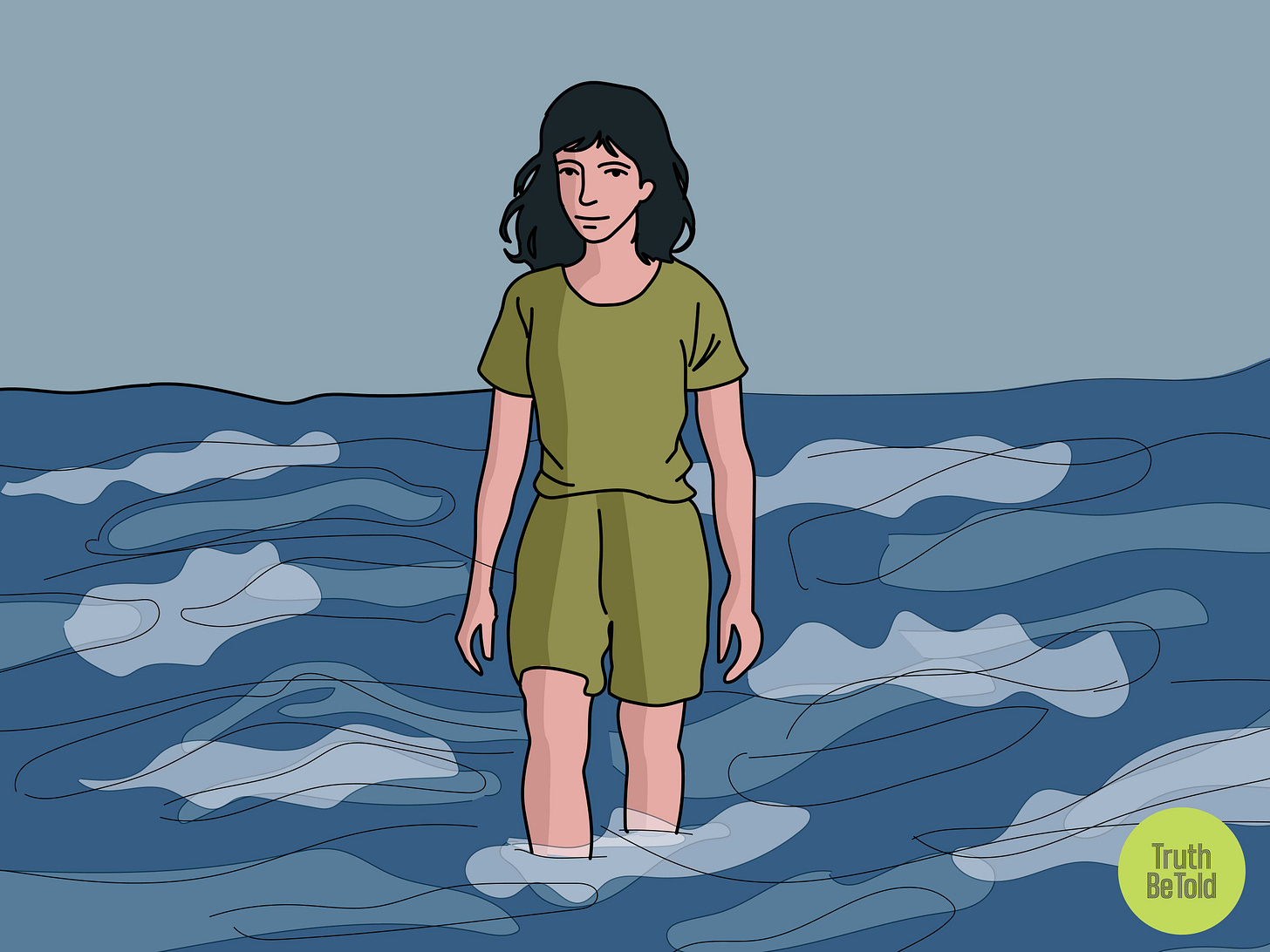
Stage 3: Being able to co-exist with it. Illustration by Sayali Kulkarni
So what actually helps when you're in the thick of grief?
V. What Helped (And What Didn't)
For me personally, I had bucketloads of rage and sadness, and it gave me tunnel vision. I threw myself into work. I chose to cut off from friends and acquaintances, from ‘normal life’ and from socialising in general.
To be clear: I don’t recommend this.
I was lucky to have a loved one show up every day and make space for me (bawling and howling or just checking out of situations, whatever I needed) and I will say this meant the world. It still does.
I would in retrospect tell myself and those of you who might want to hear it:
• Give yourself a moment of grace when you need it. Or ten.
• Yell if you need to.
• Punch a pillow if you need to.
• Write your feelings out.
• Have a conversation with your loved ones.
• Take time out if you need it.
• Tell people you don’t want to talk about it if you don’t.
Advice for friends:
• Don’t tell people to ‘be strong’ or ‘man up’ or anything remotely like this.
• Don’t offer unsolicited advice.
• Don’t share trite phrases like, ‘Things happen for a reason’.
• Don’t tell someone to get over it.
• Don’t try to offer a solution or think you can fix it.
• Do show up. With food. With hugs. With silence if that’s what your friends need.
• Hold space. Even if it feels awkward for you.
• Follow their lead—if your friend wants you to talk about other stuff, please do.
• From the conversations I’ve had with people, I can tell you that people hurt very easily when they’re that vulnerable and torn apart after a loved one dies.
• Please don’t ask too many questions. Folks will open up in their own time when they want to.
• Don’t try to share ‘the news’ with others: Death isn’t a piece of news or gossip.
• Do take care of yourself as well. (Vent to someone else if you need to.)
People do remember who shows up and who doesn’t – even in that haze. Even if you can’t make the prayer rites or cremation or burial, you can drop a note or text. Even if you feel awkward, you can always send a message of condolence.
> ‘I’m so sorry for your loss’ or a simple ‘I’m thinking of you and your family. Deepest condolences’.
For close friends, better than a ‘I’m here for you if you need anything’ is something specific you can offer.
> ‘I’m here for you and I’d love to bring you some supplies; anything on your list?’
>
> ‘I’m nearby and was just wondering: do you want to me to walk your dog today?’
>
> ‘I’m dropping by with some food; we don’t have to sit and chat if you’d rather not’.
And finally, a huge one—if you know you know (and I’m sorry).
The friends and acquaintance and family visits and calls tend to drop off after the first few weeks. People will feel very alone, very soon.
So, do remember to check in on your friends as and when you can, even after a month. And on the ‘special days’. We love to remember our loved ones year-round but that first year of ‘days’ they’re missing is just so much. It could be a birthday or a milestone life event.
Nobody will prepare you for any of these stages—how your heart will break all over again when you start thinking you’ve forgotten a voice or a laugh or a look. When you realise they’ll miss all your future life events and birthdays and anniversaries. When you wish you could ask them questions that only they could answer.
So a friend or relative or someone with no agenda remembering your person and connecting that back to you? That’s such an act of kindness. At a literary festival some time ago where I was talking about my new novel, someone who knew them said ‘your parents—your father— would be so proud’. And that really hit me in the feels.
It may not feel like it in the moment, but we’re not alone. We are always holding death’s hand, says therapist Bakul Dua, sharing very bravely and movingly from her own harrowing experience of losing her parents in quick succession.
YouTube video: ‘We’re holding death’s hand all the time’ — therapist Bakul Dua on the SayAgain podcast
She also shared that the famous stages of grief we sometimes hear about by Elisabeth Kübler-Ross—which include denial, negotiation, and acceptance—were actually articulated and posited about the terminally ill.
So the last piece of unsolicited advice? Don’t judge yourself for what you’re feeling or get stressed about which stage of grief you might be in, and most importantly don’t listen to anyone who says you need to be ‘over’ something because a certain amount of time has passed.
Grief really is a tribute to how deeply you’ve loved and how meaningful someone’s life was.
You can email for more information on the therapist-facilitated Grief Listening and Talking Circles: team@healthcollective.in